MONIMEGA
  • Blog
    • Politics
    • Software
    • Technology
    • Business
    • Design
    • Hardware
    • Health
    • Italy
    • Music
    • Sports
    • Strategy
    • World
  • Contatto
  • Galleria
  • Informazioni
  • Servizi
  • Zach Bryan Announces 2026 Tour Dates With MJ Lenderman, Dijon, and More

    Zach Bryan Announces 2026 Tour Dates With MJ Lenderman, Dijon, and More

    November 24, 2025
    Music

    Zach Bryan has announced a 2026 tour that features support from MJ Lenderman, Dijon, Alabama Shakes, Kings of Leon, and others. The country superstar’s With Heaven on Tour begins in the United States in March. Bryan will then perform across Europe and the United Kingdom, before returning to North America in July. See the tour dates below.

    Bryan released his latest studio album, The Great American Bar Scene, on Independence Day in 2024. He’s followed it with a number of singles, including “High Road,” “Blue Jean Baby,” “Madeline” (featuring tour opener Gabriella Rose), and the Kings of Leon collaborations “Bowery” and “We’re Onto Something.” He’s also suggested that a new project called With Heaven on Top could arrive on Friday, January 9, 2026.

    Read about Zach Bryan’s “Pink Skies” at No. 79 in Pitchfork’s “The 100 Best Songs of 2024.”

    Zach Bryan: With Heaven on Tour
    Zach Bryan: With Heaven on Tour
    Buy Now at Ticketmaster
    Buy Now at StubHub

    Zach Bryan:

    03-07 St. Louis, MO – The Dome at America’s Center ^$
    03-14 Tampa, FL – Raymond James Stadium ^$
    03-21 San Antonio, TX – The Alamodome ^$
    03-28 Baton Rouge, LA – Tiger Stadium ^$
    04-11 Louisville, KY – L&N Federal Credit Union Stadium #$
    04-18 Charlotte, NC – Bank of America Stadium ^$
    04-25 Lincoln, NE – Memorial Stadium #$
    05-02 Starkville, MS – Davis Wade Stadium *$
    05-09 Cleveland, OH – Huntington Bank Field *$
    05-27 San Sebastián, Spain – Donostia Arena £¢
    05-31 Berlin, Germany – Waldbühne £¢
    06-03 Oslo, Norway – Unity Arena £¢
    06-06 Copenhagen, Denmark – Parken £¢
    06-09 Eindhoven, Netherlands – Philips Stadion £¢
    06-12 Liverpool, England – Anfield *
    06-14 Edinburgh, Scotland – Scottish Gas Murrayfield *
    06-16 London, England – Tottenham Hotspur Stadium *
    06-17 London, England – Tottenham Hotspur Stadium *
    06-20 Cork, Ireland – Páirc Uí Chaoimh *
    06-21 Cork, Ireland – Páirc Uí Chaoimh *
    06-23 Belfast, Northern Ireland – Boucher Playing Fields *
    06-24 Belfast, Northern Ireland – Boucher Playing Fields *
    07-31 San Diego, CA – Snapdragon Stadium ∞
    08-01 San Diego, CA – Snapdragon Stadium ∞
    08-07 Salt Lake City, UT – Rice-Eccles Stadium ∞
    08-13 Denver, CO – Empower Field at Mile High ∞
    08-14 Denver, CO – Empower Field at Mile High ∞
    08-22 Arlington, TX – AT&T Stadium ∞
    09-05 Glendale, AZ – State Farm Stadium ∞
    09-18 Dover, DE – The Woodlands #Ω
    09-19 Dover, DE – The Woodlands √¶Ω
    10-02 Foxborough, MA – Gillette Stadium ÷Ω
    10-03 Foxborough, MA – Gillette Stadium ÷Ω
    10-10 Auburn, AL – Jordan-Hare Stadium ÷Ω

    ^ with Caamp
    $ with J.R. Carroll
    # with Kings of Leon
    * with Dijon
    £ with Ben Howard
    ¢ with Keenan O’Meara
    ¶ with Fey Fili
    ∞ with MJ Lenderman
    Ω with Gabriella Rose
    √ with Alabama Shakes
    ÷ with Gregory Alan Isakov


    Source: RSS: News.

  • Jimmy Cliff, Groundbreaking Reggae Singer, Dies at 81

    Jimmy Cliff, Groundbreaking Reggae Singer, Dies at 81

    November 24, 2025
    Music

    Jimmy Cliff, the Jamaican singer who was instrumental in taking reggae global, has died. Cliff’s wife, Latifa Chambers, and his family announced the news in a post on the singer’s social media pages, giving the cause as a seizure followed by pneumonia. Cliff was 81 years old.

    Born James Chambers, Jimmy Cliff was a star of stage and screen, as well known for his role in the revolutionary cult film The Harder They Come as for his export of ska and reggae music across the Atlantic and back to North America. His breakout in late 1960s London followed a determined rise out of poverty in Jamaica, where he had graduated from playing Elvis Presley covers in singing contests to releasing a string of ska hits that helped the genre, fueled by the introduction of the electric bass guitar, create a party-starting fervor in Kingston.

    That local success prompted a teenage Cliff’s signing to Britain’s fledgling Island Records. Upon arriving in Britain, however, Cliff “found people were not really into reggae music,” as he told Vivien Goldman in 1979. “They were more into American R&B, so I started to blend the two.” That fusion came to bear on his first two albums, released by Island: 1967’s Hard Road to Travel and his self-titled 1969 LP. The latter album spawned a UK Top 10 single in “Wonderful World, Beautiful People” (which lent its title to later pressings of the album), as well as “Vietnam,” which Bob Dylan is said to have called “the best protest song ever written.”

    As Cliff rose in the public eye, Jamaica was in a period of social upheaval, with reggae as its soundtrack. Cliff cheered his working-class compatriots from afar, later telling the writer Lloyd Bradley in Bass Culture: When Reggae Was King that the desire for political change had forced rude-boy culture to evolve into a search “for something deeper” after independence. He went on, “As they started looking towards our own culture—like the government had been encouraging people to do—that led them to look more towards Africa and some sort of Black consciousness. That’s what the roots movement was all about.… Since things had been getting bad for quite a few years, they stepped up their fight to be heard and it was the musicians that provide that voice for them.”

    Cliff returned to his native country, in 1969, where he soon swaggered into the lead role in The Harder They Come, director Perry Henzell’s electrifying drama about post-colonial Kingston youth. The first homemade feature produced in independent Jamaica, the 1972 release was a slow-burning word-of-mouth sensation, as was Cliff’s soundtrack. The album’s mix of reggae standards and Cliff originals rapidly accelerated the 1970s roots reggae boom, minting Cliff a superstar and setting the stage for Bob Marley—whom Cliff had given an early break in Kingston—and his major-label debut with the Wailers, Catch a Fire, soon after.


    Source: RSS: News.

  • Best Black Friday Thunderbolt dock deals

    Best Black Friday Thunderbolt dock deals

    November 24, 2025
    Hardware

    Black Friday deals on laptop docking stations and Thunderbolt docks have begun, and I’m on the hunt for the best docking station sales for the 2025 holiday season. Welcome to Black Week, the period leading up to Black Friday and Cyber Monday.

    I’ve tracked the best laptop docking-station sales for the past several years. For 2025, I’d expect to see predominantly Thunderbolt 4 and USB4 (the generic equivalent) docks to be on sale this holiday season, since Thunderbolt 5 docks are generally aligned with gaming PCs.

    I’ve listed each dock deal below, together with an explanation of why I picked them. Although I check multiple retailers and e-tailers, most of the top deals in years past have been on Amazon. Feel free to review the deals below, or else review my list of the best Thunderbolt docks and check to see how those prices have been affected for Black Friday sales. I’ve attached a FAQ at the end of this page with additional buying advice.

    • Plugable Thunderbolt 4 Dock, Thunderbolt 4, $131.95 (41% off at Amazon)
    • Kensington SD5000T5, Thunderbolt 5, 140W charging, $195.90 (50% off at Amazon)
    • Ugreen Thunderbolt 4 Dock 8-in-1, Thunderbolt 4, 85W charging, $161.48 (35% off at Amazon)
    • OWC Thunderbolt Go Dock, Thunderbolt 4, 90W charging, $199.99 (20% off at Amazon)
    • CalDigit TS4 Thunderbolt 4 Dock, Thunderbolt 4, 98W charging, $303.99 (32% off at Amazon)
    • OWC Thunderbolt Hub, Thunderbolt 4, 60W charging, , $85.90 (34% off at Amazon)

    This year, I made the decision this year to phase out older Thunderbolt 3 docks, as the functionally equivalent Thunderbolt 4 docking stations provide a better experience.

    If you’re looking for the best Thunderbolt 4 dock deal on right now, Plugable’s dock is the best available. Please ignore Plugable’s marketing toward the Apple Mac: this dock works just fine for Windows PCs, without any special drivers. The only hitch is that it requires your displays to have an HDMI connection, which virtually all do.

    Normally, I wouldn’t think of putting “Thunderbolt 5” and “deal” in the same sentence. But Kensington’s SD5000T5 is a really solid deal for any dock right now, especially if you’re looking to future-proof your desktop. Kensington’s SD5000T5 suffered a bit as the first Thunderbolt 5 dock I looked at, though it’s reasonably priced for premium hardware. I’ve included it as one of the first good Thunderbolt 5 docking station sales I’ve seen for Black Friday.

    Otherwise, I think the uGreen Thunderbolt 4 dock offers the best deal. Our sister site TechAdvisor reviewed the Ugreen 8-in-1 dock we recommend, and assigned it four out of five stars. I reviewed the slightly larger Ugreen Revodok Max 213 myself. It was our best Prime Day dock deal at $160.

    I’ve reviewed OWC’s Thunderbolt Go dock, and it earned four out of five stars. It’s $100 off MSRP.

    CalDigit’s TS4 is also pretty pricy, but it earned top marks from our sister site, TechAdvisor. OWC’s Thunderbolt 4 also performed quite well in TA’s review, too. This is usually one of those docks everyone wants to buy, and it’s on a decent sale.

    Anker’s Anker Prime Docking Station is 40% off or $161.49 on Amazon, but that’s a USB-C docking station that uses a 10Gbps connection. We’ve also reviewed quite a few Thunderbolt docking stations in our list of the best Thunderbolt docks, which includes real-time pricing information…so you can check those for sales, too!

    Black Friday: The best PC deals around

    Check out our roundups for the best PC-related deals in a wide variety of categories!

    • Best Amazon Black Friday tech deals
    • Best Buy’s best Black Friday tech deals
    • Best Black Friday laptop deals
    • Best Black Friday Chromebook deals
    • Best Black Friday mini PC deals
    • Best Black Friday desktop computer deals
    • Best Black Friday monitor deals
    • Best Black Friday USB flash drive deals
    • Best Black Friday SSD and storage deals
    • Best Black Friday Thunderbolt dock deals
    • Best Black Friday power bank deals
    • Best Black Friday office chair and desk deals
    • Best Black Friday VPN deals

    FAQ


    1.

    When is Black Friday?

    Officially, this year’s Black Friday takes place on Friday, Nov. 28, 2025. Cyber Monday is the following Monday, or Dec. 1, 2025. Amazon’s Black Week kicks off Nov. 20.

    2.

    What should you pay for a Black Friday deal on a Thunderbolt dock?

    Premium Thunderbolt docks usually retail for about $220 to $270 or so, depending upon the features. I usually hope for $200 or less, but we’ll see.

    Though Thunderbolt 3 and Thunderbolt 4 (and USB3 and USB4) docks all include the same basic feature set, it’s likely that retailers and e-tailers have sold through their old Thunderbolt 3 hardware. (If this confuses you, please see our list of the best Thunderbolt docks and the explanation for the different features.) This probably leaves Thunderbolt 4 / USB4 as the default choice.

    I may recommend one or two deals on Thunderbolt 5 docking stations, but Thunderbolt 5 is a premium platform with little need for you to buy it right now. None of the 2026 mobile processor platforms will integrate Thunderbolt 5 directly, favoring Thunderbolt 4 instead.

    3.

    When do Black Friday deals on Thunderbolt docks begin?

    Black Friday sales have already begun at several retailers. Retailers haven’t been shy about using early sales to unload inventory before the Black Friday craziness begins.

    Over the years, I’ve found that certain retailers simply outdo others in specific product categories. I routinely search sites like Newegg, B&H, Target, and Walmart, but Amazon typically has the best collection of deals on docking stations of all stripes, including Thunderbolt docks.

    4.

    I have a USB-C port on my laptop. How do I know what to use with it?

    Consult your laptop’s manual. A Thunderbolt port may be labeled with a small lightning-bolt logo, but that icon can sometimes be used to signal that the port can be used for charging, too. If nothing else, a USB-C dongle/hub will always work with a USB-C port.

    5.

    I still don’t understand the difference between USB-C and Thunderbolt. How does it all work?

    USB ports have been around for years. USB-C (the oval-shaped port) replaced USB-A (the rectangular port) because USB-C was more versatile, with higher speeds and a reversible port connector. USB-C ports can be rated for either 5Gbps or 10Gbps, just like a normal USB-A port. But some USB-C ports connect to a Thunderbolt chip inside your laptop, and this allows the port to run at a higher 40Gbps speed. Physically, the connector looks exactly the same. It’s just what it can do that’s different.

    Thunderbolt 5 is slowly entering the market, but with only one or two docks and a tiny number of laptops right now. I thought you wouldn’t see any major sales on Thunderbolt 5 docks this holiday season, but I’ve been since proven wrong!

    6.

    What’s the difference between a USB-C hub and a Thunderbolt dock?

    Speed and features. A USB-C hub connects to a single 4K (or 1080p) display and provides a mix of ports: USB-A, SD card slots, and so on. You can usually plug your laptop’s USB-C power cable (if it uses one) right into it.

    A Thunderbolt dock supplies even more bandwidth for more ports. There are two key differences: It has enough bandwidth to drive a pair of 4K displays, and many docks come with their own power supply that can charge your laptop as well as your phone. All that occurs via the Thunderbolt cable that connects your laptop to the dock.

    7.

    My laptop has USB 4, not Thunderbolt. Can I use a Thunderbolt dock?

    Yes and no. Thunderbolt 3, Thunderbolt 4, and USB 4 all run at 40Gbps across the same connector. USB 4 is identical to Thunderbolt 4. But if your laptop runs USB 4, it won’t “understand” Thunderbolt 3 protocols. USB 4 laptops, which are still rare, have AMD Ryzen chips inside.

    8.

    Is Thunderbolt 4 better than Thunderbolt 3?

    Physically, they use the same USB-C cable. Functionally, they’re almost the same, and run at the same 40Gbps throughput. Thunderbolt 4 was released almost as a patch to Thunderbolt 3, ensuring that everything worked properly. If your laptop has Thunderbolt, you should be able to buy either a Thunderbolt 3 or Thunderbolt 4 dock without any problems.

    Since Thunderbolt 3 is being phased out, you’ll probably find more discounts on the older Thunderbolt 3 hardware. (For all the gory details, see my roundup of the best Thunderbolt docks.)

    9.

    I own a desktop PC. Do I need a Thunderbolt dock?

    Possibly. Historically, the back of a desktop has been chock-full of I/O ports, especially DIY models that you build yourself. Desktops usually have extra room for internal SSDs, SD cards, and so on. However, if your desktop lacks these things, and if it includes an external Thunderbolt port, you can always add these additional components externally via Thunderbolt.


    Source: PCWorld.

  • Testing Reinvented: Why Test Coverage Is the Wrong Metric

    November 24, 2025
    Software

    When testing consumes considerable amount of your development cycle, AI changes everything. But most organizations are optimizing for the wrong goal.

    I have guided engineering organizations through every major technology evolution over the past two decades, including the migration from manual QA to automated suites, waterfall phases to continuous testing in DevOps pipelines.

    The AI transformation is different. It requires reconceiving what testing means and who does it.

    Traditional testing treated quality as verification. Write code, write tests (or vice versa when using TDD), run tests, fix bugs. AI makes that sequence obsolete. When AI generates comprehensive test suites in hours, analyzes production telemetry to identify untested paths, and predicts failures before they happen, the bottleneck shifts from test creation to test strategy. The constraint is no longer how many tests we write but which tests matter.

    Test coverage is a vanity metric. It measures what percentage of code has been executed, not whether the right behaviors are validated or critical risks are addressed. Microsoft and Google research shows 70 to 80 percent code coverage often correlates with less than 50 percent meaningful defect detection. Teams hit coverage targets while shipping production failures because they measured execution, not effectiveness.

    The problem deepens with AI-generated code. When AI produces hundreds of lines in seconds, writing tests to cover those lines becomes trivial. But those tests validate syntax without interrogating logic, check happy paths without exploring edge cases, and verify implementation details instead of business intent. Coverage numbers climb while quality stagnates.

    Traditional testing operates reactively. Developers write code, then tests, then discover problems, then fix them. When AI generates prototypes in hours, this sequential approach creates bottlenecks. Organizations accelerate development but maintain waterfall testing phases, optimizing artifact velocity while leaving the fundamental constraint untouched.

    Tools like ContentSquare and Google Analytics consistently reveal that users interact with applications in ways developers never anticipated. They access features in unexpected sequences, use mobile devices for desktop-designed workflows, and encounter edge cases that seemed improbable during development. The gap between tested scenarios and real-world usage represents systematic risk that traditional testing never addresses.

    The required shift: from measuring activity to measuring outcomes. Not how many tests exist but which risks are mitigated. Not coverage but effectiveness.

    The New Paradigm: From Reactive Testing to Predictive Quality Engineering

    AI transforms testing from verification into a continuous intelligence system operating as an integrated loop: AI generates tests from specifications before code exists, predicts failure modes based on code patterns and historical data, validates behavior continuously as code evolves, learns from production telemetry to identify gaps, and feeds insights back to improve specifications and future strategies.

    Testing moves upstream. Instead of writing tests after code, AI generates comprehensive test suites from requirements before implementation begins. These tests become executable contracts that guide development rather than trailing indicators.

    Testing becomes predictive. AI analyzes code patterns, architectural decisions, and historical failure data to identify high-risk areas before testing begins.

    Testing operates continuously. Rather than batch testing at phase gates, AI validates every change in real time. Developers receive immediate feedback on what broke, why it matters, and which downstream systems are affected. Cycle time from commit to validated build drops from hours to minutes.

    Testing learns. Production telemetry and user behavior analytics feed back to test generation. When users encounter edge cases or user behaviour tools reveals workflow abandonment or feature usage patterns diverging from design assumptions, these insights become test cases. The test suite evolves based on actual usage patterns.

    Quality engineering emerges as a distinct discipline. QA professionals shift from manually executing test scripts to designing test strategies, evaluating AI-generated test effectiveness, establishing quality signals and thresholds, governing risk-based testing approaches, and orchestrating feedback loops between testing, development, and production operations.

    The Five-Step Playbook for AI-Native Testing

    Step 1. Generate Tests from Specifications, Not Code

    What: Use AI to create comprehensive test suites directly from requirements, design documents, and API contracts before implementation begins.

    Why it matters: Test-Driven Development has always been the gold standard but rarely practiced because writing tests before code requires effort and discipline. AI eliminates the friction. When tests exist before implementation, they guide development rather than trailing it.

    How to do it: Provide AI with structured specifications including inputs, expected outputs, constraints, edge cases, and failure scenarios. Use tools like GitHub Copilot or Cursor to generate test scaffolding. Create property-based tests that validate behavior across input ranges rather than specific examples. Generate contract tests validating API agreements between services. Establish test templates encoding your organization’s quality standards so AI-generated tests inherit these patterns automatically. Implement specification reviews before development to ensure tests validate the right behaviors.

    Pitfall to avoid: Generating tests from existing code rather than specifications. That validates what was built, not what should have been built. The test suite becomes a mirror of implementation rather than a contract for correctness. If requirements are ambiguous, AI generates ambiguous tests. Invest in specification clarity before test generation.

    Metric and signal: Percentage of tests generated before implementation. Time from specification to executable test suite. Defect detection rate in AI-generated versus human-written tests. Developer feedback on whether tests clarified requirements before coding.

    Step 2. Implement Risk-Based Testing with AI Prediction

    What: Use AI to analyze code complexity, change patterns, historical failures, and architectural dependencies to predict where defects are most likely and concentrate testing effort accordingly.

    Why it matters: Uniform test coverage wastes resources. Not all code carries equal risk. A critical payment processing module demands more rigorous validation than a cosmetic UI adjustment. AI makes risk assessment systematic and data-driven.

    How to do it: Implement AI-powered risk scoring evaluating cyclomatic complexity, recent change frequency, historical defect density, number of dependencies, security sensitivity, and production incident correlation. Use tools like Microsoft’s AI-assisted testing framework or build custom risk models using your organization’s historical data. Establish risk tiers with explicit testing requirements. High-risk changes require comprehensive test coverage, security scanning, performance validation, and manual review. Medium-risk changes get automated functional testing and architectural review. Low-risk changes receive smoke tests and automated validation only. Create feedback loops where production incidents automatically elevate risk scores for affected modules.

    Pitfall to avoid: Treating AI risk scores as deterministic rather than probabilistic. AI predictions guide resource allocation but do not replace engineering judgment. A low-risk score means apply appropriate rigor relative to actual risk, not skip testing. Overriding AI recommendations should be easy when context justifies it but tracked so patterns inform future models.

    Metric and signal: Correlation between AI risk scores and actual production defects. Reduction in testing time while maintaining or improving defect detection. Percentage of high-severity production incidents flagged as high-risk during testing. Engineering satisfaction with risk-based testing approaches.

    Step 3. Build Continuous Validation Loops

    What: Integrate AI testing throughout the development workflow so every code change receives immediate validation feedback rather than waiting for batch test runs.

    Why it matters: Delayed feedback creates rework. When developers discover test failures hours later during CI pipeline runs, they context-switch away from the problem. Immediate validation enables correction while cognitive context is fresh. Defects caught within minutes cost 10 times less to fix than defects discovered hours or days later.

    How to do it: Implement AI-powered validation at multiple integration points. In the IDE, AI provides real-time feedback as developers write code, identifying potential issues before commit. During code review, AI analyzes changes and automatically generates relevant tests or identifies missing test coverage for critical paths. In CI pipelines, AI selects which tests to run based on code changes rather than executing the entire suite, reducing build times from hours to minutes. After deployment, AI monitors production telemetry and generates tests for observed edge cases or unexpected behaviors. Establish quality gates with clear criteria at each integration point. Create dashboards showing validation results in real time.

    Pitfall to avoid: Generating too many tests that slow the development cycle. AI can produce thousands of tests easily. More tests do not equal better quality. Focus on test effectiveness, not volume. Establish thresholds for test execution time and prune low-value tests regularly. Balance thoroughness with velocity.

    Metric and signal: Time from code commit to validation feedback. Percentage of defects caught before code review versus during testing versus in production. Developer productivity measured by feature delivery velocity with quality maintained. Test execution time trends to ensure pipelines remain fast as test suites grow.

    Step 4. Evolve Tests with Production Learning

    What: Use production telemetry, user behavior analytics, and incident data to continuously improve test strategies and generate new tests that validate real-world usage patterns.

    Why it matters: Developers cannot anticipate every edge case or usage pattern. Users find scenarios that test suites miss. The gap between what developers test and what users actually do represents untested risk.

    How to do it: Implement multiple data streams capturing different dimensions of production reality. Technical telemetry from APM tools and logging platforms captures error conditions, performance anomalies, resource utilization patterns, and security events. User behavior analytics from ContentSquare, Google Analytics, Mixpanel, or Amplitude reveals how users actually interact with your application: navigation paths taken versus paths assumed, feature usage frequency and adoption rates, abandonment points where users leave workflows incomplete, device and browser combinations triggering issues, rage clicks and error frustration indicators, and session replay data showing exact user experiences during failures.

    Use AI to synthesize these data streams and identify critical testing gaps. A ContentSquare heatmap showing users repeatedly clicking a non-interactive element indicates missing feedback that testing never validated. Google Analytics revealing 40 percent of users access a feature on mobile despite desktop-only design exposes untested responsive behavior. Session replays capturing checkout failures on specific browser and payment method combinations generate precise test scenarios.

    Automatically generate tests reproducing these real-world patterns. Connect User behaviour tools to your test management platform through APIs. Configure alerts that trigger test generation when behavior anomalies exceed thresholds. When production incidents occur, AI generates comprehensive regression tests validating both the technical fix and the user experience. Tag tests with their origin whether specification-based, code-based, telemetry-based, or analytics-based so you understand your test portfolio composition.

    Pitfall to avoid: Treating every production event or user behavior as a test case. ContentSquare might show thousands of interaction patterns. Google Analytics reveals countless navigation paths. Focus on critical paths, conversion flows, security issues, data integrity problems, and user-impacting failures. Establish criteria for when production observations warrant new tests: frequency thresholds for behavior patterns, business impact of affected workflows, correlation with errors or abandonment, and security or compliance implications.

    Metric and signal: Percentage of test cases derived from production data and behavior analytics versus developer assumptions. Reduction in repeat production incidents. Correlation between high-traffic user paths from analytics and test coverage for those paths. Reduction in unexpected user behavior reported by support teams.

    Step 5. Redefine QA as AI Quality Supervision

    What: Transform QA professionals from test script executors to AI quality engineers who design test strategies, evaluate AI effectiveness, and govern quality standards.

    Why it matters: Manual testing cannot keep pace with AI-accelerated development. Organizations that invest in QA evolution see quality improve while testing costs decline.

    How to do it: Train QA teams on AI testing tools, prompt engineering for test generation, risk-based testing methodologies, and metrics measuring test effectiveness rather than coverage. Redefine QA responsibilities to include designing quality strategies that AI executes, reviewing AI-generated tests for completeness and relevance, establishing quality thresholds and acceptance criteria, governing test frameworks and standards across teams, analyzing quality trends and recommending improvements, and partnering with engineering to build testability into architecture and design. Create new career paths for AI quality engineers with clear progression from test execution to quality strategy to organizational quality leadership. Provide premium tools and training to QA professionals who embrace the transition.

    Pitfall to avoid: Assuming all QA professionals will adapt to AI-centric roles. Some will embrace the transition. Others prefer manual testing. Support both groups but make clear that manual testing is a declining path. Offer retraining resources and transparent communication about role evolution timelines. Gradual evolution with support enables success.

    Metric and signal: QA satisfaction scores with new tools and responsibilities. Percentage of QA time spent on strategy versus execution. Quality metrics including defect escape rate, time to detection, and production incident trends. Organizational perception of QA value before and after transformation.

    What to Start, Stop, Continue

    For Executives

    Start: Measuring test effectiveness rather than coverage. Allocating budget for AI testing platforms and QA retraining. Treating quality as a continuous intelligence system. Establishing clear career paths for QA professionals evolving to quality engineering roles.

    Stop: Demanding higher coverage percentages without measuring defect detection. Cutting QA headcount because AI automates testing without investing in AI quality supervision capabilities. Treating testing as a cost center to minimize. Accepting production incidents as inevitable when AI-powered predictive testing could prevent them.

    Continue: Investing in engineering excellence and quality discipline. Demanding evidence that testing strategies deliver results. Supporting experimentation with new testing approaches. Building organizational capabilities for continuous learning from production.

    For Engineers

    Start: Generating tests from specifications before writing code. Using AI risk scoring to prioritize testing effort. Integrating continuous validation into your development workflow. Contributing production learnings back to test strategies. Treating QA professionals as quality engineering partners.

    Stop: Measuring testing success by coverage percentages. Writing tests only after code is complete. Ignoring test failures because they seem flaky. Assuming AI-generated tests are automatically correct without review. Viewing testing as someone else’s responsibility.

    Continue: Applying rigorous review standards to all tests whether human or AI generated. Advocating for quality at every stage of development. Sharing successful testing patterns with your organization. Demanding that architecture and design prioritize testability.

    Strategic Takeaway

    Testing is not becoming automated. Testing is becoming intelligent.

    The organizations that understand this distinction are building sustainable competitive advantage. Automated testing executes predefined scripts faster. Intelligent testing predicts where failures will occur, generates validation strategies that match actual risk, learns continuously from production, and evolves to match how systems are actually used.

    This transformation requires reconceiving what quality means in an era where code generation is cheap and validation is sophisticated. Test coverage optimizes for execution activity. Test effectiveness optimizes for risk mitigation and behavior validation. That shift changes everything about how engineering organizations approach quality.

    Organizations clinging to coverage metrics and phase-gate testing will build AI-accelerated technical debt. They will generate more tests that validate less. Organizations embracing test effectiveness and continuous quality intelligence will deliver faster with fewer production failures because they are optimizing for the right outcomes.

    In software delivery, quality is not just a feature. It is the foundation of everything else. Speed without quality creates fragility. Features without reliability erode trust. Testing reinvented means quality engineering elevated from cost center to strategic capability.

    If this challenges your current testing approach, that is the point. The organizations winning in the AI era are the ones willing to question their assumptions and rebuild their operating models around what actually works.

    Share your perspective if you are rethinking testing strategy. Challenge this framework if you see gaps.

    The best operating models emerge from debate, not consensus. Engineering and product leaders need to shape this transformation together because how we ensure quality is changing faster than most organizations are adapting.


    Source: DEV Community.

  • Pocket Casts rolls out playlists, so users can sequence episodes of their favorite shows

    November 24, 2025
    Hardware

    There are millions upon millions of podcast episodes out there and it can be tough to figure out what to listen to and when. The popular podcast service Pocket Casts is rolling out a playlists feature to help users make sense of it all.

    This is being advertised as a “new way for listeners to organize, sequence and customize episodes across all their favorite shows.” The idea of a playlist isn’t new by any stretch, but it’s not typically an option on podcast apps. As a matter of fact, Pocket Casts says this was one of its most-requested features.

    The platform says this tool is great for “building a morning news lineup, curating interviews to study a topic or creating a queue for a long flight.” There’s a manual option but also an automatic Smart Playlists feature that gathers episodes together based on pre-determined rules.

    The playlists feature.
    Pocket Casts

    For instance, episodes can be collected and sorted by release date, duration and other factors. This replaces the pre-existing filters tool. I can absolutely see this being useful on a road trip when you don’t really wanna fiddle with a phone and would rather just let the podcast episodes flow into one another to create a Conan O’Brien-induced driving zen state.

    The playlists tool is available right now. This is just the latest move by Pocket Casts. The service recently added a free tier for accessing its web player and desktop app. We love it when things get cheaper, don’t we folks?

    This article originally appeared on Engadget at https://www.engadget.com/entertainment/pocket-casts-rolls-out-playlists-so-users-can-sequence-episodes-of-their-favorite-shows-170046666.html?src=rss


    Source: Engadget is a web magazine with obsessive daily coverage of everything new in gadgets and consumer electronics.

  • 'Bel-Air': Jabari Banks and Cast Talk the Final Season

    'Bel-Air': Jabari Banks and Cast Talk the Final Season

    November 24, 2025
    Hardware

    Nearly 30 years after ’90s sitcom The Fresh Prince of Bel-Air aired its last episode, fans will tune in to watch the dramatic — and modern — reimagining of the show, Bel-Air, kick off its fourth and final season. The series returns to Peacock on Nov. 24, wrapping up Jabari Banks’ role as Will Smith in this dramatic retelling that follows the young kid from West Philly who goes to live with family in the affluent Bel-Air neighborhood of Los Angeles. Who knew a gritty fan-made trailer would spawn four seasons? 

    “The confidence of Will. Being confident even if you don’t know your next move — moving with intention and then going through life without taking no for an answer,” said Banks. He added that Will evolves throughout the show to the very end, and it’s been amazing to see where his character ends up, even defying expectations along the way. One thing that gets stronger is Will’s brotherly bond with Carlton.

    Carlton has a high point in season 4, according to Sholotan, who’s played the role of Will’s once-antagonistic cousin and high school classmate. The first three seasons saw him beef with Will, hide addiction from his family and run with the wrong (and sometimes racist) crowd before eventually owning his ways. He even starts a business with Will: Blackcess. 

     “In my opinion, Carlton’s defining moment is when he checks Connor,” said Sholotan, referencing a confrontation in the first episode of season 4. He reflected on how much his character’s grown since season 1, where “he doesn’t really understand what’s wrong” with racial slurs being used so casually by his so-called friends. Sholotan added that he felt like a proud big brother toward Carlton in that moment and noted that it was really important to him, given Carlton’s history.

    Coco Jones’ Hilary Banks may share her keen fashion sense with the ’90s OG version, but she experiences real challenges that are all her own. Still, Jones gleaned an insightful reminder from playing the eldest child in the family. 

    “Maybe something that I’m reminded of when I portray Hilary is that you can have all the things that people think are going to make your life perfect, and still no one is exempt from life being life,” she said. “Sometimes, I myself find myself thinking, ‘Dang, I know her life is eating, or, wow, I know it’s really great over there.’ But you never know what’s going on outside of that ZIP code, outside of that net worth — outside of that perception they put on the internet,” Jones said. 

    Simone Joy Jones could relate to her character, Lisa, as a young woman growing up in LA who’s learning to push boundaries and have agency over her life, a theme fans will see as the show progresses. Freeman shared a similar sentiment about how Aunt Viv’s story has been the opposite of the “trad life.”

    According to Akingbola, seasons 3 and 4 “are the yang to Geoffrey’s yin.” His mysterious ways begin to unravel, and the stakes get high enough to where “You don’t know. Will Uncle Phil and Geoffrey be OK? You don’t know.” 

  • Emotions Manifest as Uncanny Scenarios in Ayako Kita’s Tender Sculptures

    Emotions Manifest as Uncanny Scenarios in Ayako Kita’s Tender Sculptures

    November 24, 2025
    Design

    Emotions Manifest as Uncanny Scenarios in Ayako Kita’s Tender Sculptures

    Combining hand-carved Japanese cypress with crystal-clear acrylic resin, Ayako Kita sculpts tender, emotive figures. For her current exhibition, The End of the Day Begins at FUMA Contemporary Tokyo, she focuses on the transitional moment of returning home, in which seemingly mundane tasks like switching on a light or opening a curtain are imbued with consequence, frozen in time.

    Kita’s work emphasizes an often introspective world, where a young woman or girl’s consciousness, emotions, and anxieties manifest in uncanny scenarios. The titles usually offer important clues, too. In “me & me,” for example, an extra pair of legs is literally tethered to the character’s own limbs, as if another half-formed parallel version of her person is always present. And change is in the air in “Premonition,” where a slightly apprehensive expression is accompanied by a gust of wind.

    a small sculpture by Ayako Kita made of cypress and acrylic resin, depicting a young woman with a dress made of clear material so that we can see right through her
    “Premonition” (2022), Japanese cypress and acrylic resin, 29 x 17 x 11 centimeters

    In her most recent work, the figures exhibit expressions of curiosity, thoughtfulness, and faint concern, gazing directly at the viewer, as if seeing us unexpectedly across a room or out a window. “When I began to think about creating a world in which all the pieces would connect as one continuous story, this series naturally came to mind,” Kita says in a statement.

    The End of the Day Begins includes works the artist has made throughout the past five years. Her newest pieces combine figures with furnishings and architectural elements, a theme she first explored when she was a student. “Rather than a return to my origins, this production became a time to reaffirm that these scenes still exist vividly within me,” she says.

    The End of the Day Begins continues through November 29 in Tokyo. Follow Kita on Instagram for updates. You might also enjoy the multifaceted woodcarvings of Yoshitoshi Kenamaki.

    a small sculpture by Ayako Kita made of cypress and acrylic resin, depicting a young woman with a clear dress and an extra pair of legs, with two ankles bound together
    “me & me” (2020), Japanese cypress and acrylic resin, 30 x 22.5 x 15 centimeters
    a small sculpture by Ayako Kita made of cypress and acrylic resin, depicting a young woman or girl holding the string of a ceiling light
    “Night Falls” (2025), Japanese cypress and acrylic resin, 55 x 21.5 x 18.5 centimeters
    a series of five small sculptures by Ayako Kita made of cypress and acrylic resin, depicting young women or girls in various emotional states
    a small sculpture by Ayako Kita made of cypress and acrylic resin, depicting a young woman or girl with a clear dress, dropping a bowl of cereal
    “Let go of everything” (2024), Japanese cypress and acrylic resin, 33.5 x 20.5 x 14 centimeters
    a small sculpture by Ayako Kita made of cypress and acrylic resin, depicting two female figures connected via a three-dimensional pixellation
    “Causality” (2021), Japanese cypress and acrylic resin, 30 x 30 x 15 centimeters
    a small sculpture by Ayako Kita made of cypress and acrylic resin, depicting a young woman standing beside a large red curtain
    “Shut Down” (2025), Japanese cypress and acrylic resin, 51 x 30 x 21 centimeters
    a series of five small sculptures by Ayako Kita made of cypress and acrylic resin, depicting young women or girls in various emotional states
    a small sculpture by Ayako Kita made of cypress and acrylic resin, depicting a young woman walking up a short flight of blue-gray steps and looking back
    “Today Ends Here” (2025), Japanese cypress and acrylic resin, 47 x 32 x 26.5 centimters

    Do stories and artists like this matter to you? Become a Colossal Member today and support independent arts publishing for as little as $7 per month. The article Emotions Manifest as Uncanny Scenarios in Ayako Kita’s Tender Sculptures appeared first on Colossal.


    Source: Colossal.

  • The Oura Ring 4 Is $100 Off Ahead of Black Friday

    The Oura Ring 4 Is $100 Off Ahead of Black Friday

    November 24, 2025
    Technology

    health and fitness tracker that doesn’t require you to wear a big, bulky watch? You can grab an Oura Ring 4 for just $249 from Amazon, a $100 break from the normal price. It’s compatible with both iOS and Android apps, has a battery that last for days, and accurately tracks a ton of health data, from hiking and sleeping to period predictions and food intake.

    • Image may contain: Accessories, Jewelry, Ring, Silver, Platinum, and Tape
      Photograph: Simon Hill
    • Image may contain: Body Part, Finger, Hand, Person, Accessories, Jewelry, Ring, Baby, and Silver
      Photograph: Simon Hill

    Oura

    Ring 4

    $349

    Oura

    $399 $299 (25% off)

    Amazon

    $349

    Best Buy

    This generation of the Oura smart ring has a number of major improvements, but the biggest upgrade is to the overall wearability. The sensors have been recessed further into the body of the ring itself, which reduces the overall thickness considerably and allows for a wider available range of ring sizes. They also cover a wider portion of the ring, so there’s no need to keep it oriented in one specific direction to get proper readings.

    The battery life has improved a lot as well. The older Oura 3 could run for around three days before it needed a charge, Our reviewer, Adrienne So, reported that the Ring 4 tracked a full weekend of hiking and physical activity, as well as a music festival, and still had enough juice for at least a couple more days.

    You get a ton of health and physical fitness data from the ring, which is neatly sorted into daily physical data, detailed vitals, and longer trends over time, all organized in the app on your phone. If you want to also keep track of your food intake, a new Meals feature lets you take photos of what you eat and then track its effects on your body. Oura has also worked with Natural Cycles, a fertility tracking app, to predict periods using your basal body temperature.

    The Oura Ring 4 is an impressive health and fitness tracker in a surprisingly small package, and one of the only downsides from our review was the price point for the silver-colored finishes. Thankfully, the mirrored silver and classic black are marked down to the lower $249 price point, with varying discounts on the other options, like $299 for the brushed silver, or a larger $150 discount to bring the gold down to just $349.


    Source: Wired.

  • IBM and Cisco agree to lay the foundations for a quantum internet —  companies announce plans to build a distributed quantum computing network, linking fault-tolerant systems over long distances

    IBM and Cisco agree to lay the foundations for a quantum internet — companies announce plans to build a distributed quantum computing network, linking fault-tolerant systems over long distances

    November 24, 2025
    Hardware

    IBM and Cisco have announced plans to jointly build a distributed quantum computing network capable of linking fault-tolerant systems over long distances. In an announcement on Thursday, November 20, the companies said they aim to demonstrate a two-machine entanglement proof-of-concept by 2030, with the ultimate goal of enabling scalable quantum workloads that span multiple sites and processors. If successful, the collaboration would mark a shift in how quantum computing resources are deployed, moving beyond single-system scale to a federated architecture capable of trillions of quantum operations.

    The initiative will combine IBM’s superconducting qubit hardware with new networking infrastructure from Cisco, including microwave-optical transducers, quantum network control layers, and physical and software routing protocols designed for entangled quantum state transmission.

    The proposed architecture is intended to support fault-tolerant quantum computers already in IBM’s development roadmap. But it would also require the creation of new intermediary hardware — a planned ‘Quantum Networking Unit’, or QNU — to interface with IBM’s quantum processors and translate static quantum states into flying qubits suitable for transmission via photonic links.

    The duo’s ambitions will be built upon a three-tier model that splits qubit modules, networking transduction interfaces, and optical entanglement layers. IBM’s Quantum Processing Unit (QPU) roadmap projects logical fault-tolerant machines with several hundred logical qubits. each requiring thousands of physical qubits, by 2030.

    Cisco’s role is to link these cryogenic environments together. Entanglement between processors would be achieved using shared photon pairs or teleportation-style protocols, with photon-based carriers transmitted over optical fiber or potentially free-space links.

    Because IBM’s superconducting qubits operate in the microwave scale, while long-distance transmission favors optical frequencies, a high-efficiency transducer is needed to convert quantum information from one format to another. That device — capable of preserving coherence and phase relationships between microwave and optical domains — will have to be developed and is one of the key technical hurdles of the roadmap.

    The companies say the initial milestone will be to link two independent QPUs located in separate cryogenic systems. This will test both hardware entanglement and software synchronization layers. If successful, a scaled version of the architecture would allow for modular quantum computing networks, where computation is distributed across many small fault-tolerant nodes, and entanglement is dynamically allocated based on the structure of the problem being solved.

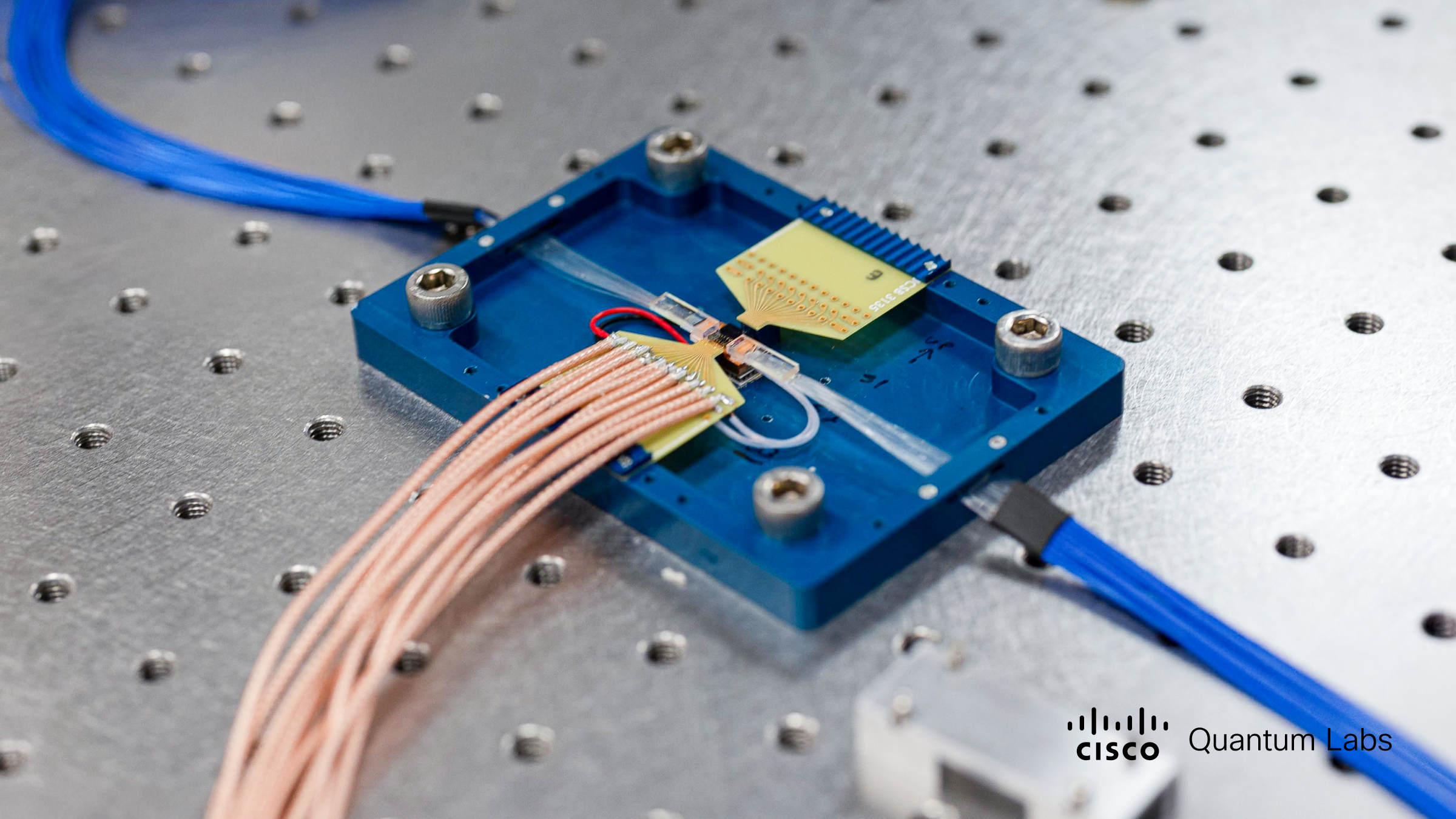
    A Cisco quantum network entanglement chip.

    An image of Cisco’s Quantum Networking Entanglement Chip. (Image credit: Cisco)

    Why networks

    IBM’s vision of scalable quantum computing has already shifted from single-monolithic machines toward what it calls quantum-centric supercomputing. Under that model, quantum processors function as accelerators embedded within larger high-performance compute environments, connected to CPUs, GPUs, and shared storage via classical interfaces. However, some workloads, especially those involving chemistry, material science, or cryptographic search, will require quantum circuits with hundreds of millions or billions of gates.

    Running those circuits within the coherence window of a single device is infeasible, even under optimistic hardware timelines. Instead, IBM’s roadmap assumes inter-processor coordination, allowing large algorithms to be divided into subcircuits that can run on separate QPUs. This would enable workloads that exceed the qubit count or gate fidelity of any single machine.

    The QNU plays a central role here, acting as the entanglement interface between QPUs. While some early experiments in microwave-to-optical transduction have been demonstrated in lab settings — including at Fermilab’s SQMS Center, where an IBM partnership is planned — the level of fidelity and error rate required for distributed fault-tolerant computing is still years away from production.

    The companies are also working on software protocols that manage entanglement routing across the network. Unlike classical networks, where bits can be duplicated and retransmitted, quantum systems depend on ephemeral, one-time-use states. That means entangled links must be established just-in-time, managed through a new class of control protocols that coordinate not only logical dataflow but also the physical movement of qubit states. Cisco says it will contribute a high-speed software protocol framework to support these operations.

    Quantum computing internet

    The long-term vision goes well beyond inter-device communication. IBM and Cisco say their roadmap could extend into a future quantum internet where quantum processors and entangled photonic links form a planetary-scale network of physically distributed (but logically connected) resources.

    The idea of a quantum internet has been proposed before. Several research groups have published designs for node-based or repeater-style architectures, but most of those are focused on specific applications such as quantum key distribution or secure messaging. IBM’s goal, however, is to make distributed compute a viable path for running quantum algorithms that can’t fit in memory on a single machine.

    If achieved, it could allow new types of applications, from supply chain modelling to real-time climate simulation using quantum-enhanced sensing. IBM has suggested that such networks could support “trillions of quantum gates” across multiple QPUs, far beyond the practical limits of even a thousand-logical-qubit monolithic device.

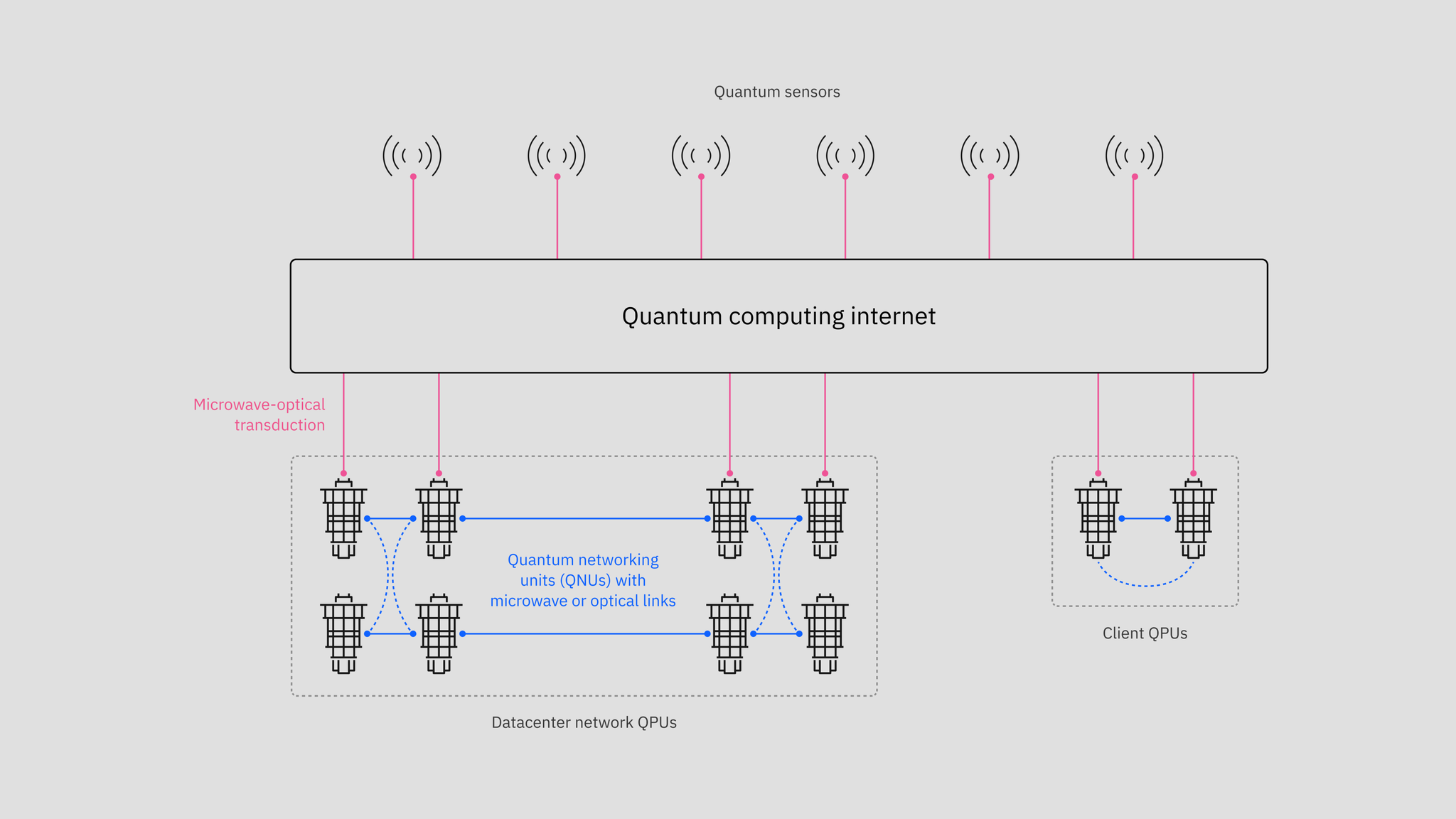
    IBM's future vision for quantum computing at scale includes quantum processing units(QPUs) networked over shorter distances in data centers, and over longer distances to potentially connect to quantum sensors and on-premises systems

    IBM’s future vision for quantum computing at scale includes quantum processing units (QPUs) networked over shorter distances in data centers, and over longer distances to potentially connect to quantum sensors and on-premises systems. (Image credit: IBM)

    A long road ahead

    The 2030 timeline for demonstrating a basic entanglement between two QPUs is extremely ambitious. A scalable multi-node quantum network is expected to follow just a few years later, with long-distance networking only arriving in the latter half of that decade. The quantum internet vision, where processors and entangled repeaters span entire regions, is likely more than 15 years out.

    Some significant engineering challenges will need to be overcome to make this timeline a reality. No existing transducer meets the required efficiency and fidelity thresholds for scalable links. Meanwhile, distributed quantum error correction is still in development, and most of the proposed network protocols are theoretical or exist only in research simulations. There is also the challenge of integrating Cisco’s photonic networking expertise with IBM’s cryogenic systems in a way that minimizes thermal interference and maximizes link yield.

    After more than a decade of pushing processor design, IBM is now turning its attention to interconnects. Cisco, for its part, is betting that quantum computing will need entirely new systems thinking, where classical routing is blended with real-time entanglement management.

    It is a different way to think about infrastructure, not just as a transport layer, but as a co-designed part of the computational pipeline itself. If IBM and Cisco can build it, they’ll be reshaping what it means to run a program when the processor is no longer a single machine.

    Follow Tom’s Hardware on Google News, or add us as a preferred source, to get our latest news, analysis, & reviews in your feeds.

    Google Preferred Source


    Source: Latest from Tom’s Hardware.

  • Exclusive: Saudi Arabia to open more alcohol stores as curbs ease, sources say – Reuters

    November 24, 2025
    World

    Exclusive: Saudi Arabia to open more alcohol stores as curbs ease, sources say

      Reuters


    Source: “site:reuters.com” – Google News.

Previous Page
1 … 57 58 59 60 61 … 911
Next Page
MONIMEGA
  • Instagram
  • Facebook
  • Twitter
Gestisci Consenso
Per fornire le migliori esperienze, utilizziamo tecnologie come i cookie per memorizzare e/o accedere alle informazioni del dispositivo. Il consenso a queste tecnologie ci permetterà di elaborare dati come il comportamento di navigazione o ID unici su questo sito. Non acconsentire o ritirare il consenso può influire negativamente su alcune caratteristiche e funzioni.
Funzionale Always active
L'archiviazione tecnica o l'accesso sono strettamente necessari al fine legittimo di consentire l'uso di un servizio specifico esplicitamente richiesto dall'abbonato o dall'utente, o al solo scopo di effettuare la trasmissione di una comunicazione su una rete di comunicazione elettronica.
Preferenze
L'archiviazione tecnica o l'accesso sono necessari per lo scopo legittimo di memorizzare le preferenze che non sono richieste dall'abbonato o dall'utente.
Statistiche
L'archiviazione tecnica o l'accesso che viene utilizzato esclusivamente per scopi statistici. L'archiviazione tecnica o l'accesso che viene utilizzato esclusivamente per scopi statistici anonimi. Senza un mandato di comparizione, una conformità volontaria da parte del vostro Fornitore di Servizi Internet, o ulteriori registrazioni da parte di terzi, le informazioni memorizzate o recuperate per questo scopo da sole non possono di solito essere utilizzate per l'identificazione.
Marketing
L'archiviazione tecnica o l'accesso sono necessari per creare profili di utenti per inviare pubblicità, o per tracciare l'utente su un sito web o su diversi siti web per scopi di marketing simili.
  • Manage options
  • Manage services
  • Manage {vendor_count} vendors
  • Read more about these purposes
Visualizza le preferenze
  • {title}
  • {title}
  • {title}