King Gizzard & the Lizard Wizard have announced what they are calling their only U.S. dates of 2026. The band will perform at New York’s Forest Hills Stadium in August. Plus, the Australian rockers are bringing back their Field of Vision music festival. That’s set for August 14-16 at Meadow Creek, in Buena Vista, Colorado. See King Gizzard & the Lizard Wizard’s tour dates, including imminent shows in Australia, below.
Joining King Gizzard & the Wizard Lizard at Field of Vision II are: Blood Incantation, Die Spitz, DJ Crenshaw, Earth Tongue, Etran de L’Aïr, Folk Bitch Trio, Lisa Bella Donna, Pattie Gonia, and Upchuck. Check out a poster for the festival below.
“Field of Vision I was so special. Anyone who was there would tell you there was some magic in the air. Or maybe the creek water,” the band said in a press release. “So grateful to party with you all again. Love, the Gizzards.”
12-03 Sydney, Australia – Sydney Opera House * 12-04 Sydney Australia – Enmore Theatre $% 12-05 Sydney Australia – Enmore Theatre $% 12-07 Brisbane, Australia – Fortitude Music Hall $ 12-09 Brisbane, Australia – The Princess Theatre & 12-10 Brisbane, Australia – The Princess Theatre & 12-12 Melbourne, Australia – Sidney Myer Music Bowl ^! 12-13 Melbourne, Australia – Sidney Myer Music Bowl ~ 08-14-16 Buena Vista, CO – Meadow Creek (Field of Vision II) 08-20 Queens, NY – Forest Hills Stadium 08-21 Queens, NY – Forest Hills Stadium 08-22 Queens, NY – Forest Hills Stadium
* with Sydney Symphony Orchestra $ with Party Dozen % with Destrends & with Queensland Symphony Orchestra ^ with Orchestra Victoria ! with Folk Bitch Trio ~ with Barkaa
Prices on DDR5 are out of control, but Newegg has a bundle going that makes picking up a kit more bearable. The bundle brings together 32GB of Corsair Vengeance RGB DDR5-6400 CL36 memory, an MSI X870 Gaming Plus Wi-Fi motherboard, and a Corsair iCue Link H115i cooler for $409.98. That’s $3 more than buying the memory alone, essentially giving you the motherboard and cooler for free.
The bundle is technically only for the memory and motherboard, but Newegg is throwing in the Corsair cooler as a freebie right now. You’ll still need to get a CPU, but if you pick up one of the many deals on Zen 4/5 CPUs right now, you can make out with nearly a full rig without spending much.
This Newegg bundle brings together a 32GB kit of Corsair Vengeance DDR5-06400 CL36 memory, an MSI X870 Gaming Plus Wi-Fi motherboard, and a Corsair iCue Link H115i cooler for nearly half off.
The fact that you’re getting a free motherboard and cooler with a DDR5 purchase is already attractive, but even the prices on the individual components in this bundle are good. Less than two months ago, we highlighted a deal on the MSI X870 Gaming Plus Wi-Fi when it dropped to $210. Now, you’re getting it essentially for free.
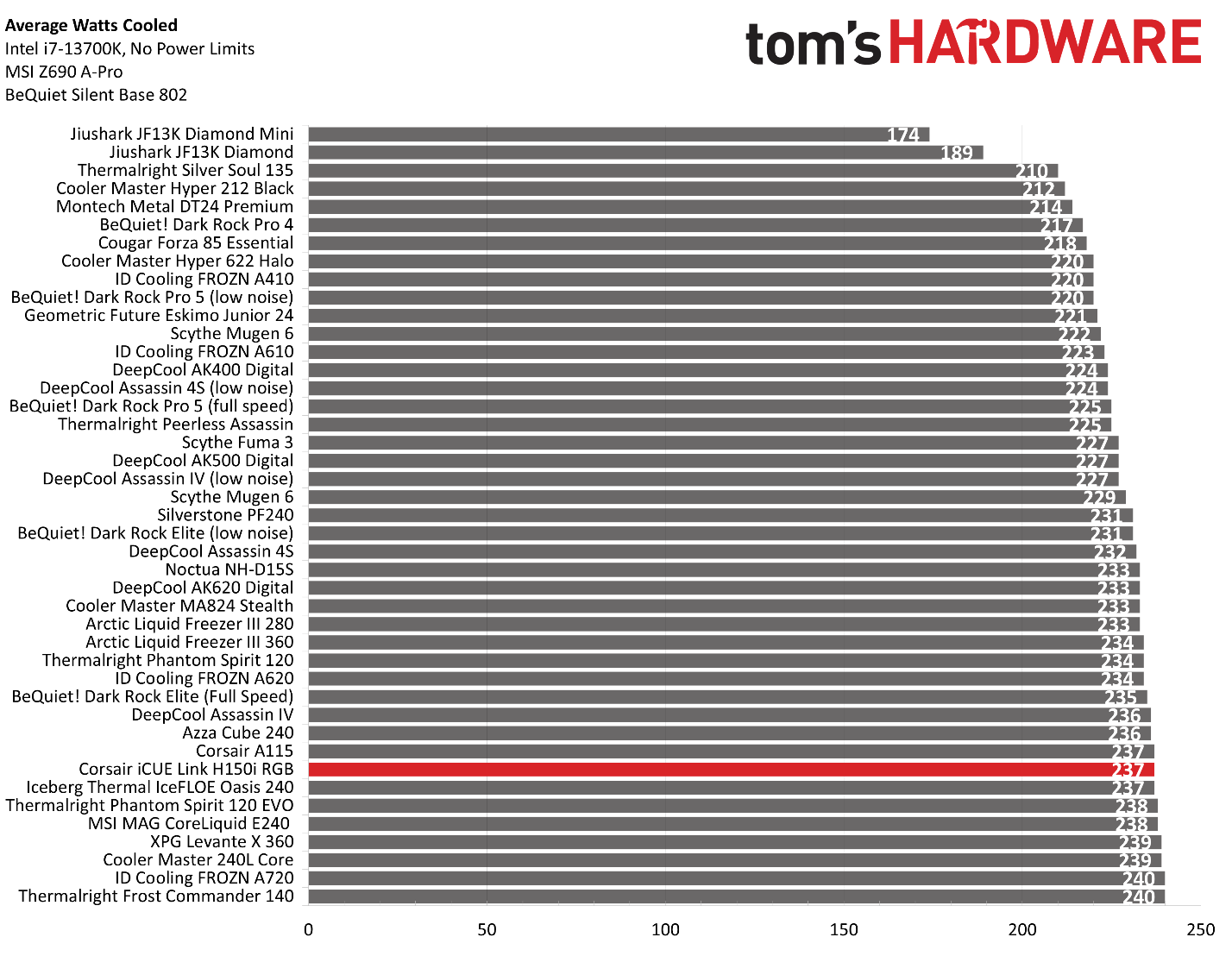
The cooler is the component we have the most testing experience with. We knocked down the Corsair iCue Link H150i (the 360mm version) a bit in our review due to its insanely high price. Here, however, that isn’t a factor.
(Image credit: Tom’s Hardware)
The H150i is a bit behind comparable 240mm coolers, but not by much. The H115i included in this bundle is a 280mm cooler, which is more than enough for all but the most power-hungry chips on the market; and those, at the moment, mostly live in Intel’s camp with Raptor Lake and Raptor Lake Refresh flagships.
The motherboard features AMD’s X870 chipset, which isn’t technically its flagship offering. X870E boards offer a few extra bells and whistles, but the MSI X870 Gaming Plus Wi-Fi is still packed with features. It sports a 14+2+1 VRM design, memory speeds up to 8,200MT/s, Wi-Fi 7, 5-Gigabit LAN, and MSI’s EZ DIY clips, allowing you to install your M.2 drives without a screwdriver.
It also includes PCIe 5.0 on the top x16 slot and the top M.2 slot. Those two slots don’t share any PCIe lanes, so you can get the full speed of PCIe 5.0 on both your storage and GPU.
Thankfully, the DDR5 kit isn’t bad here, either. It’s a DDR5-6400 CL36 kit. We normally point buyers toward DDR5-6000 kits as the “sweet spot” of memory speeds, but the slightly lower CAS latency on this kit means it comes out with less latency than your standard DDR5-6000 CL38 kit. Plus, there’s RGB.
The staff of Pitchfork listens to a lot of new music. A lot of it. On any given day our writers, editors, and contributors go through an imposing number of new releases, giving recommendations to each other and discovering new favorites along the way. Each Monday, with our Pitchfork Selects playlist, we’re sharing what our writers are playing obsessively and highlighting some of the Pitchfork staff’s favorite new music. The playlist is a grab-bag of tracks: Its only guiding principle is that these are the songs you’d gladly send to a friend.
This week’s Pitchfork Selects playlist features Lolina, Na-Kel Smith, Ulrika Spacek, and more. Listen below and follow our playlists on Apple Music and Spotify. (Pitchfork earns a commission from purchases made through affiliate links on our site.)
Pitchfork Selects: December 2, 2025
Isobel Waller-Bridge: “Tapes” Lolina: “GG” The Null Club: “Overgrown” [ft. Miss Grit] Na-Kel Smith: “Money2Tall” Ulrika Spacek: “Square Root of None” Parent Teacher: “NVD//A”
HBM is undergoing its first major architectural overhaul in a decade, as HBM4, HBM4E, and C-HBM4E will introduce a 2048-bit interface, logic-node base dies, and optional custom memory logic inside base dies, enabling up to a 2.5X performance leap between 2025 and 2027.
The pick of the midweek La Liga clashes sees table-topping Barcelona welcome Athletico Madrid, which has been on a run of good form, to the newly refurbished Camp Nou. A brace from Dani Olmo helped Barca to a 3-1 victory over Alaves last Saturday, a result which moved Hansi Flick’s team to the top spot. With rivals Real Madrid having been held to an unexpected 1-1 stalemate against Girona on Sunday, the game on Tuesday offers Barca an opportunity to stretch its lead to a potential four points.
They face an Atlético Madrid team that could draw level on points with the Blaugrana should they win today. Diego Simeone’s side will likely feel confident of pulling off what would be a third away win of the campaign. The Rojiblancos are on a superb run of seven consecutive victories across all competitions, including six straight wins in La Liga.
Barcelona faces Atlético Madrid at Spotify Camp Nou on Tuesday, Dec. 2. Kickoff is set for 4:15 p.m. CET local time, 3 p.m. ET or 12 p.m. PT in the US and Canada, 3:15 p.m. GMT in the UK, and a 7 a.m. AEDT kickoff in Australia on Wednesday morning.
This match is available to stream in the US through ESPN Select, which has live English- and Spanish-language broadcast rights for La Liga in the US.
Livestream Barcelona vs. Atlético Madrid in the UK
Premier Sports is the home for the lion’s share of live Spanish top-flight match broadcasts this season in the UK. The network is showing 340 matches live, including this game, which will be shown exclusively live on its Premier Sports 1 channel and Premier Sports Player.
Premier Sports
A subscription to the dedicated Premier Sports La Liga channel costs £8 a month. You can also get the channel via a full subscription to Premier Sports, giving you access to all of the network’s channels, which have the UK broadcast rights to Scottish Premiership matches, BKT United Rugby Championship and Investec Champions Cup rugby, plus NHL and Nascar. A full Premier Sports subscription costs £10 per month for Sky and Virgin TV customers. You can also get Premier Sports through Amazon Prime Video as an add-on for £15 a month.
Livestream Barcelona vs. Atlético Madrid in Canada
TSN is the rights holder for live coverage of La Liga matches in the region. Select games are shown on its linear channels, and a wider selection is shown on its TSN Plus streaming platform. This match is set to be shown on TSN 1 and TSN Plus.
BeIn Sports
beIN Sports is available in Australia for AU$15 a month or a yearly commitment of AU$130.
Taken from a vertical perspective, Kevin Krautgartner’s photographs of crashing waves conjure the power and beauty of our oceans. Captured along the coast of Western Australia, the images revel in the clarity and textures of the water and shoreline, where “wind, swell, and underwater topography creates some of the most powerful and visually striking wave formations I’ve ever encountered,” he says.
Krautgartner’s latest series is titled Waves | Ocean Forces. Turquoise water swirls, sprays, rolls, and washes over the sand, focused so specifically that the phenomenon appears nearly abstracted. The artist spends time planning and waiting for ideal weather conditions and swells in order to snap the high-resolution images, some of which he plans to transform into large-format prints.
While taking an analytical approach to waves, considering their physical properties and geologic impact, Krautgartner is also interested evoking our emotional connection to the ocean. “Waves have always fascinated me—not just as shapes, but as fleeting configurations of energy shaped by global and local forces,” he says. “What drew me to Western Australia was the possibility to witness this process at its most intense and most precise.”
Krautgartner’s work is currently on view through the end of January with Livia Lisboa Fotokunst in Hamburg, and he’s prepping for another solo exhibition in 2026. Find more on Behance, Instagram, and his website, where you can purchase prints.
Peaches has shared a new song, “Fuck Your Face,” along with details of her first album in more than a decade, No Lube So Rude. That album, announced in October, will be Peaches’ first for the beloved indie label Kill Rock Stars, and it’s due on February 20, 2026. Check out the new song and the album artwork below, along with her tour dates, including a new European run next spring.
The first single from Peaches’ Rub follow-up was “Not in Your Mouth None of Your Business,” which got a Boys Noize remix last month. Both the original version of that and today’s “Fuck Your Face” are written and produced by Peaches and the Squirt Deluxe. An age-restricted “Fuck Your Face” visual is available on YouTube.
01 Hanging Titties 02 Fuck Your Face 03 No Lube So Rude 04 Whatcha Gonna Do About It 05 Panna Cotta Delight 06 Fuck How You Wanna Fuck 07 Not in Your Mouth None of Your Business 08 Take It 09 Grip 10 You’re Alright 11 Be Love
Franck Nijhof—better known as Frenck—is one of those maintainers who ended up at the center of a massive open source project not because he chased the spotlight, but because he helped hold together one of the most active, culturally important, and technically demanding open source ecosystems on the planet. As a lead of Home Assistant and a GitHub Star, Frenck guides the project that didn’t just grow. It exploded.
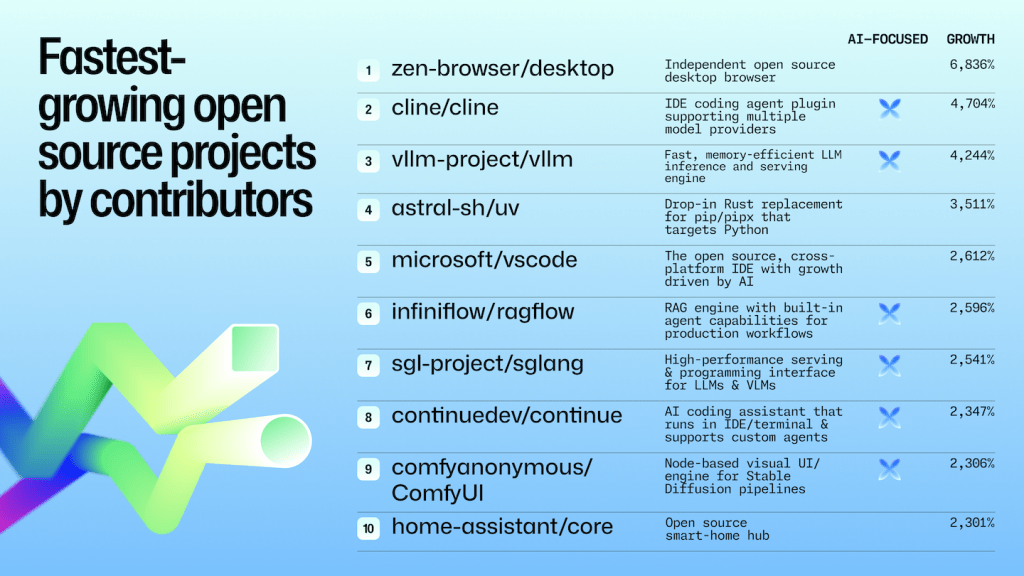
This year’s Octoverse report confirms it: Home Assistant was one of the fastest-growing open source projects by contributors, ranking alongside AI infrastructure giants like vLLM, Ollama, and Transformers. It also appeared in the top projects attracting first-time contributors, sitting beside massive developer platforms such as VS Code. In a year dominated by AI tooling, agentic workflows, and typed language growth, Home Assistant stood out as something else entirely: an open source system for the physical world that grew at an AI-era pace.
The scale is wild. Home Assistant is now running in more than 2 million households, orchestrating everything from thermostats and door locks to motion sensors and lighting. All on users’ own hardware, not the cloud. The contributor base behind that growth is just as remarkable: 21,000 contributors in a single year, feeding into one of GitHub’s most lively ecosystems at a time when a new developer joins GitHub every second.
In our podcast interview, Frenck explains it almost casually.
Home Assistant is a free and open source home automation platform. It allows you to connect all your devices together, regardless of the brands they’re from… And it runs locally.
Franck Nijhof, lead of Home Assistant
He smiles when he describes just how accessible it is. “Flash Home Assistant to an SD card, put it in, and it will start scanning your home,” he says.
This is the paradox that makes Home Assistant compelling to developers: it’s simple to use, but technically enormous. A local-first, globally maintained automation engine for the home. And Frenck is one of the people keeping it all running.
At its core, Home Assistant’s problem is combinatorial explosion. The platform supports “hundreds, thousands of devices… over 3,000 brands,” as Frenck notes. Each one behaves differently, and the only way to normalize them is to build a general-purpose abstraction layer that can survive vendor churn, bad APIs, and inconsistent firmware.
Instead of treating devices as isolated objects behind cloud accounts, everything is represented locally as entities with states and events. A garage door is not just a vendor-specific API; it’s a structured device that exposes capabilities to the automation engine. A thermostat is not a cloud endpoint; it’s a sensor/actuator pair with metadata that can be reasoned about.
That consistency is why people can build wildly advanced automations.
Frenck describes one particularly inventive example: “Some people install weight sensors into their couches so they actually know if you’re sitting down or standing up again. You’re watching a movie, you stand up, and it will pause and then turn on the lights a bit brighter so you can actually see when you get your drink. You get back, sit down, the lights dim, and the movie continues.”
A system that can orchestrate these interactions is fundamentally a distributed event-driven runtime for physical spaces. Home Assistant may look like a dashboard, but under the hood it behaves more like a real-time OS for the home.
Running everything locally is not a feature. It’s a hard constraint.
Almost every mainstream device manufacturer has pivoted to cloud-centric models. Frenck points out the absurdity:
It’s crazy that we need the internet nowadays to change your thermostat.
The local-first architecture means Home Assistant can run on hardware as small as a Raspberry Pi but must handle workloads that commercial systems offload to the cloud: device discovery, event dispatch, state persistence, automation scheduling, voice pipeline inference (if local), real-time sensor reading, integration updates, and security constraints.
This architecture forces optimizations few consumer systems attempt. If any of this were offloaded to a vendor cloud, the system would be easier to build. But Home Assistant’s philosophy reverses the paradigm: the home is the data center.
Everything from SSD wear leveling on the Pi to MQTT throughput to Zigbee network topologies becomes a software challenge. And because the system must keep working offline, there’s no fallback.
This is engineering with no safety net.
The open home foundation: governance as a technical requirement
When you build a system that runs in millions of homes, the biggest long-term risk isn’t bugs. It’s ownership.
“It can never be bought, it can never be sold,” Frenck says of Home Assistant’s move to the Open Home Foundation. “We want to protect Home Assistant from the big guys in the end.”
This governance model isn’t philosophical; it is an architectural necessity. If Home Assistant ever became a commercial acquisition, cloud lock-in would follow. APIs would break. Integrations would be deprecated. Automations built over years would collapse.
The Foundation encodes three engineering constraints that ripple through every design decision:
Privacy: “Local control and privacy first.” All processing must occur on-device.
Choice: “You should be able to choose your own devices” and expect them to interoperate.
Sustainability: If a vendor kills its cloud service, the device must still work.
Frenck calls out Nest as an example: “If some manufacturer turns off the cloud service… that turns into e-waste.”
This is more than governance; it is technical infrastructure. It dictates API longevity, integration strategy, reverse engineering priorities, and local inference choices. It’s also a blueprint that forces the project to outlive any individual device manufacturer.
The community model that accidentally solved software quality
We don’t build Home Assistant, the community does.
“We cannot build hundreds, thousands of device integrations. I don’t have tens of thousands of devices in my home,” Frenck says.
This is where the project becomes truly unique.
Developers write integrations for devices they personally own. Reviewers test contributions against devices in their own homes. Break something, and you break your own house. Improve something, and you improve your daily life.
“That’s where the quality comes from,” Frenck says. “People run this in their own homes… and they take care that it needs to be good.”
This is the unheard-of secret behind Home Assistant’s engineering velocity. Every contributor has access to production hardware. Every reviewer has a high-stakes environment to protect. No staging environment could replicate millions of real homes, each with its own weird edge cases.
Assist: A local voice assistant built before the AI hype wave
Assist is Home Assistant’s built-in voice assistant, a modular system that lets you control your home using speech without sending audio or transcripts to any cloud provider. As Frenck puts it:
We were building a voice assistant before the AI hype… we want to build something privacy-aware and local.
Rather than copying commercial assistants like Alexa or Google Assistant, Assist takes a two-layer approach that prioritizes determinism, speed, and user choice.
Stage 1: Deterministic, no-AI commands
Assist began with a structured intent engine powered by hand-authored phrases contributed by the community. Commands like “Turn on the kitchen light” or “Turn off the living room fan” are matched directly to known actions without using machine learning at all. This makes them extremely fast, reliable, and fully local. No network calls. No cloud. No model hallucinations. Just direct mapping from phrase to automation.
Stage 2: Optional AI when you want natural language
One of the more unusual parts of Assist is that AI is never mandatory. Frenck emphasizes that developers and users get to choose their inference path: “You can even say you want to connect your own OpenAI account. Or your own Google Gemini account. Or get a Llama running locally in your own home.”
Assist evaluates each command and decides whether it needs AI. If a command is known, it bypasses the model entirely.
“Home Assistant would be like, well, I don’t have to ask AI,” Frenck says. “I know what this is. Let me turn off the lights.”
The system only uses AI when a command requires flexible interpretation, making AI a fallback instead of the foundation.
Open hardware to support the system
To bootstrap development and give contributors a reference device, the team built a fully open source smart speaker—the Voice Assistant Preview Edition.
“We created a small speaker with a microphone array,” Frenck says. “It’s fully open source. The hardware is open source; the software running on it is ESPHome.”
This gives developers a predictable hardware target for building and testing voice features, instead of guessing how different microphones, DSP pipelines, or wake word configurations behave across vendors.
Hardware as a software accelerator
Most open source projects avoid hardware. Home Assistant embraced it out of practical necessity.
“In order to get the software people building the software for hardware, you need to build hardware,” Frenck says.
Home Assistant Green, its prebuilt plug-and-play hub, exists because onboarding requires reliable hardware. The Voice Assistant Preview Edition exists because the voice pipeline needs a known microphone and speaker configuration.
This is a rare pattern: hardware serves as scaffolding for software evolution. It’s akin to building a compiler and then designing a reference CPU so contributors can optimize code paths predictably.
The result is a more stable, more testable, more developer-friendly software ecosystem.
A glimpse into the future: local agents and programmable homes
The trajectory is clear. With local AI models, deterministic automations, and a stateful view of the entire home, the next logical step is agentic behavior that runs entirely offline.
If a couch can trigger a movie automation, and a brewery can run a fermentation pipeline, the home itself becomes programmable. Every sensor is an input. Every device is an actuator. Every automation is a function. The entire house becomes a runtime.
And unlike cloud-bound competitors, Home Assistant’s runtime belongs to the homeowner, not the service provider.
Frenck sums up the ethos: “We give that control to our community.”
Per fornire le migliori esperienze, utilizziamo tecnologie come i cookie per memorizzare e/o accedere alle informazioni del dispositivo. Il consenso a queste tecnologie ci permetterà di elaborare dati come il comportamento di navigazione o ID unici su questo sito. Non acconsentire o ritirare il consenso può influire negativamente su alcune caratteristiche e funzioni.
Funzionale
Always active
L'archiviazione tecnica o l'accesso sono strettamente necessari al fine legittimo di consentire l'uso di un servizio specifico esplicitamente richiesto dall'abbonato o dall'utente, o al solo scopo di effettuare la trasmissione di una comunicazione su una rete di comunicazione elettronica.
Preferenze
L'archiviazione tecnica o l'accesso sono necessari per lo scopo legittimo di memorizzare le preferenze che non sono richieste dall'abbonato o dall'utente.
Statistiche
L'archiviazione tecnica o l'accesso che viene utilizzato esclusivamente per scopi statistici.L'archiviazione tecnica o l'accesso che viene utilizzato esclusivamente per scopi statistici anonimi. Senza un mandato di comparizione, una conformità volontaria da parte del vostro Fornitore di Servizi Internet, o ulteriori registrazioni da parte di terzi, le informazioni memorizzate o recuperate per questo scopo da sole non possono di solito essere utilizzate per l'identificazione.
Marketing
L'archiviazione tecnica o l'accesso sono necessari per creare profili di utenti per inviare pubblicità, o per tracciare l'utente su un sito web o su diversi siti web per scopi di marketing simili.





.jpg)