MONIMEGA
  • Blog
    • Politics
    • Software
    • Technology
    • Business
    • Design
    • Hardware
    • Health
    • Italy
    • Music
    • Sports
    • Strategy
    • World
  • Contatto
  • Galleria
  • Informazioni
  • Servizi
  • Provincia Vibo, centrodestra invoca dimissioni “suo ormai ex presidente” L’Andolina

    July 23, 2025
    Italy

    Corrado L'Andolina

    Riceviamo e pubblichiamo

    Consiglio della Provincia di Vibo. Chieste ufficialmente dai gruppi di centrodestra le dimissioni del presidente L’Andolina che replica ai rilievi mossigli e afferma: «Le nostre strade si sono divise.

    Non ho ancora maturato una decisione sul mio futuro istituzionale»

    L’assise approva l’avvio dell’iter amministrativo del Bilancio di previsione 2025-2027  

    Una seduta del Consiglio della Provincia di Vibo Valentia che ha approvato atti importanti come il “Rendiconto per l’esercizio 2024”, “L’avvio dell’iter d’approvazione del Bilancio di previsione 2025-2027”, e “Il Piano di dimensionamento scolastico provinciale 2026/2027”.

    Ma che alla fine è stata caratterizzata da dinamiche più di natura politica che amministrativa.

    Il centrodestra chiede ufficialmente in Consiglio le dimissioni del presidente L’Andolina

    A connaturare politicamente l’assise sono state le richieste ufficiali di dimissioni al presidente Corrado Antonio L’Andolina da parte del gruppo consiliare “Centro Destra per Vibo”, composto da Carmine Franzè, Serena Loschiavo e Vincenzo Pagnotta, e dallo schieramento “Vibo al Centro Unica e legata nella concretezza”, formato da Cosimo Nicola Papa, Alessandro Lacquaniti e Giampiero Calafati, compagini politiche, quest’ultime, che avevano entrambe sostenuto politicamente L’Andolina alle ultime elezioni provinciali.

    «Proseguire su questa strada significherebbe volere il male del nostro territorio. Riteniamo inevitabile, quindi, chiudere questa stagione politica.

    La fiducia che da sempre le abbiamo accordato è stata irrimediabilmente compromessa.

    In questo contesto l’unico atto dignitoso e risolutivo rimasto è quello delle sue dimissioni immediate. La Provincia di Vibo non può più essere ostaggio di un protagonismo sterile e autoreferenziale che danneggia non solo l’operatività dell’Ente ma anche il tessuto democratico che lo sostiene», – ha evidenziato il capogruppo di Centro Destra per Vibo, Vincenzo Pagnotta, sottolineando altresì che «il riferimento politico del gruppo consiliare che guida è Forza Italia».   

    Sulla stessa lunghezza d’onda le dichiarazioni del gruppo “Vibo al Centro Unica e legata nella concretezza”.

    «Le strade provinciali affondano, gli interventi strutturali e infrastrutturali sono inesistenti, la programmazione nelle materie di competenza provinciale è di fatto un copia incolla degli anni precedenti.

    In due anni il presidente L’Andolina è passato da una maggioranza di centro destra, a cui appartiene almeno formalmente, ad una maggioranza sostenuta da parte del centrosinistra, creando confusione e irritazione tra i cittadini», – questo uno dei passaggi cruciali dell’intervento del capogruppo Alessandro Lacquaniti.

    Che, nella chiosa finale del suo intervento, ha quindi chiesto al presidente L’Andolina a nome della compagine che rappresenta di «rassegnare le dimissioni».

    Nel contempo però «per il bene dell’Ente e del territorio e della comunità provinciale» entrambi i gruppi hanno dichiarato, nelle fasi iniziali del Consiglio, che «voteranno responsabilmente il Bilancio e il Rendiconto finanziario».

    La replica del presidente L’Andolina

    «Ho imparato a mie spese che la politica non è il luogo delle gratificazioni, ma quello dove si paga il prezzo delle proprie convinzioni.

    E l’unico metro che ho sempre adottato è stato il rispetto per l’Istituzione e per chi, ogni giorno, attende risposte concrete.

    Non nego che il comunicato di Forza Italia mi abbia colpito, più sul piano personale che su quello politico.

    Ho provato sconforto e anche dolore ma accetto la decisione. Le nostre strade si sono divise.

    Non ho ancora maturato una decisione sul mio futuro istituzionale. Porterò a termine l’iter del bilancio perché l’interesse dell’Ente e della comunità lo richiede.

    Poi, con serenità e rispetto verso tutti, sceglierò la strada che riterrò più giusta. Il bilancio va approvato perché senza l’Ente rischia un danno irreversibile. 

    Ho letto di accuse di ingratitudine. Chi mi conosce sa che non ho mai agito con cinismo ma sempre con il metro delle responsabilità, dell’equilibrio e del rispetto per le istituzioni.

    Ho sempre cercato di onorare il mio ruolo senza distinzioni di colore politico, di territorio, di appartenenza. Ho lavorato per i comuni montani e per quelli costieri, per la maggioranza e per le opposizioni.

    Ho lavorato per tutti. A tempo debito illustreremo gli interventi realizzati, le incompiute finalmente concluse, le nuove iniziative volontariamente assunte dall’ente. Grande merito va dato agli uffici e ai dipendenti.

    Il mio compito non è difendere me stesso, né inseguire un destino personale o politico. Il mio compito è garantire risposte ai cittadini, creare le condizioni perché queste risposte arrivino e assicurare continuità all’ente.

    Questo è stato e resta il mio unico orizzonte. Poi ogni strada ha il suo tempo. E ognuno, prima o poi, capisce quando è il momento di cambiare passo o fermarsi.

    Ognuno di noi, nei propri ruoli, possa però continuare a coltivare, ogni giorno, quel bene fragile e immenso che si chiama libertà».  

    Schinella (PD) “oggi si certifica un ulteriore fallimento politico del centrodestra vibonese”

    «Avrei voluto parlare di bilancio e di un rendiconto che presenta un deficit di 6 milioni di euro. Avrei voluto evidenziare l’ennesima variazione di bilancio di questa amministrazione provinciale.

    Del fatto che vengono tagliati i fondi per l’istruzione e di tanti altri contenuti d’interesse istituzionale. Oggi qui in Consiglio si è, invece, certificato il fallimento del centrodestra vibonese.

    Il fallimento del progetto politico di una destra cinica e sterile. 

    Quel che emerge in maniera chiara è la coerenza del Partito Democratico che ho l’onore e l’onere di rappresentare qui in Consiglio.

    PD che è nei fatti l’unica forza politica all’opposizione, così come dimostrato in ogni intervento e atto presentato nell’esclusivo interesse dei cittadini e del territorio».   

    I punti all’ordine del giorno approvati dal Consiglio

    Dopo questo confronto dai connotati prevalentemente politici il Consiglio, sentiti gli interventi di natura tecnica del segretario generale, Domenico Arena, e della Posizione Organizzativa, Caterina Gambino, ha approvato i seguenti punti all’ordine del giorno:
    “Rendiconto per l’esercizio 2024”;
    “Avvio iter per l’approvazione dello schema di bilancio 2025/2027”;
    “Programma territoriale della rete scolastica e dell’offerta formativa. Piano di dimensionamento scolastico provinciale 2026/2027”.

    I tre punti all’ordine del giorno affrontati sono stati approvati tutti con la medesima votazione: nove voti favorevoli ed uno astenuto.

    Hanno espresso il loro voto a favore Corrado L’Andolina, Carmine Franzè, Serena Lo Schiavo, Vincenzo Pagnotta, Cosimo Nicola Papa, Alessandro Lacquaniti, Giampiero Calafati, Nicola Lasorba e Vincenzo Lentini.
    L’unico ad astenersi è stato il consigliere Antonino Schinella.


    Source: Irriverentemente.

  • Calabria, Tis Comuni. Cgil plaude a Regione: Su vertenza, bene aumento fondi a 54mila €. Ma Comuni deliberino entro 31 luglio

    July 23, 2025
    Italy

    Riceviamo e pubblichiamo

    Accogliamo positivamente la delibera approvata oggi dalla Giunta regionale, che innalza a 54.000 euro il contributo destinato ai Comuni per ogni tirocinante TIS under 60 che sarà stabilizzato. Una misura importante, resa possibile dallo stanziamento di ulteriori 64 milioni di euro ottenuti attraverso il Programma Operativo Complementare.

    Tale dotazione potrà, in concorrenza, essere utilizzata anche per sostenere interventi su altri bacini del precariato storico calabrese, a partire dagli ex LSU/LPU.

    Il 31 luglio rappresenta l’ultima data utile entro cui i Comuni dovranno approvare le delibere di stabilizzazione. Le procedure concrete partiranno successivamente, ma senza quella delibera il percorso non potrà nemmeno cominciare.

    Con questo incremento, i Comuni avranno coperti integralmente i costi del personale stabilizzato per i primi quattro anni, grazie ai 54.000 euro garantiti dalla Regione Calabria e ai circa 2.000 euro a lavoratore provenienti dal fondo statale (5 milioni complessivi).

    Resta tuttavia aperta la questione della sostenibilità dal quinto anno in poi: al di là della programmazione interna degli enti – che potranno contare su turn over e futuri pensionamenti – è essenziale che già nella prossima Legge di Bilancio venga previsto un rafforzamento del fondo nazionale, per garantire certezza economica e continuità occupazionale.

    Per questo chiediamo che la Regione, insieme ai sindacati e ai Comuni, lavori sin da subito per ottenere un incremento strutturale del fondo statale, assicurando ulteriori risorse anche oltre la durata del contributo una tantum.

    Oggi i sindaci hanno davanti un’occasione concreta e irripetibile: procedere con le assunzioni. Chi ha le condizioni per stabilizzare, lo dimostri con atti formali. Il tempo degli alibi e delle ambiguità è finito. Adesso servono scelte chiare, coraggio amministrativo e responsabilità politica.

    Per i Comuni che, nonostante tutto, non approveranno le delibere, ribadiamo quanto già annunciato: i tirocinanti esclusi saranno accompagnati in un percorso alternativo di formazione e riqualificazione, con l’obiettivo di portarli alla sottoscrizione di un contratto al termine del tirocinio, ma non più con lo stesso ente utilizzatore.

    La Regione ha comunicato che, a partire dal primo agosto, per i lavoratori che non saranno stabilizzati si aprirà una nuova fase di formazione. Una fase che dovrà essere gestita con serietà, visione e obiettivi chiari, affinché si trasformi in un vero percorso di crescita e non in un contenitore temporaneo privo di prospettive.

    Va inoltre considerato che una parte dei tirocinanti non potrà essere stabilizzata, non per mancanza di volontà, ma perché non risultano in utilizzo presso i Comuni. È il caso, ad esempio, dei lavoratori impiegati nelle scuole, che – pur formalmente assegnatari del contributo – non possono essere assunti dalle istituzioni scolastiche, poiché le assunzioni sono di esclusiva competenza del Ministero.

    Per questi lavoratori, così come per coloro che non saranno assunti dai Comuni, la fase di formazione annunciata dalla Regione dovrà essere progettata con responsabilità e finalità concrete di reimpiego, per offrire prospettive reali e non alimentare ulteriori forme di precarietà.

    Il 31 luglio rappresenta un bivio importante: per chi può, è il momento di scegliere con coraggio la strada della stabilizzazione. Per chi non potrà farlo, dovrà essere comunque garantito un percorso alternativo di pari dignità, che riconosca il valore del lavoro svolto in questi anni e offra soluzioni concrete e credibili.

    NIdiL CGIL Calabria
    CGIL Calabria


    Source: Irriverentemente.

  • Regione, Giunta aumenta contributo a Comuni per Tis: 54mila € per ognuno stabilizzato

    July 23, 2025
    Italy

    Riceviamo e pubblichiamo. Foto Archivio

    La Giunta della Regione Calabria ha approvato una delibera con la quale incrementa da 40mila a 54mila euro il contributo.

    Che darà ai Comuni per ogni Tirocinante di inclusione sociale under 60 che le amministrazioni stabilizzeranno entro il 31 luglio 2025.

    La delibera odierna è stata possibile grazie al via libera avuto proprio oggi dal Comitato interministeriale per la programmazione economica.

    E lo sviluppo sostenibile allo stanziamento, su esplicita richiesta della Regione, di ulteriori 64milioni per la dotazione del Programma operativo complementare della Calabria.

    Gli enti utilizzatori che non stabilizzeranno i Tis – attraverso l’avvio di un formale percorso da attivare tramite il Dipartimento Lavoro – entro il 31 luglio 2025, non potranno ovviamente più usufruire delle prestazioni di supporto alla propria amministrazione dei tirocinanti di inclusione sociale.

    Per i Tis che non verranno stabilizzati la Regione Calabria provvederà, dall’1 agosto 2025, a concludere il tirocinio con un periodo di formazione fino al termine previsto dal tirocinio stesso, con l’obiettivo di riconoscere le competenze necessarie per l’inserimento nel mondo del lavoro.


    Source: Irriverentemente.

  • "If he failed, their process failed": Inside the NFLPA meltdown

    July 23, 2025
    Sports
    Jul 23, 2025, 07:57 AM ET

    ON FRIDAY NIGHT, less than a day after Lloyd Howell Jr. abruptly resigned as the embattled boss of the NFL Players Association, dozens of union representatives and alternates met during a two-hour Zoom call to try to make sense of what had just happened and find a pathway to fresh leadership.

    Patrick Mahomes, the Kansas City Chiefs‘ MVP quarterback and second alternate player rep, spoke up to rally a group that was grappling with the worst crisis in the NFLPA’s 68-year history.

    “We need to get our choice for leader right,” Mahomes said, according to four people briefed on his comments.

    Mahomes’ words came during a chaotic four days for the NFLPA, including nightly conference calls of up to four hours long.

    Sources familiar with the calls told ESPN that player reps expressed fear, frustration and worry about the NFLPA’s future. Those concerns deepened when JC Tretter, a retired Cleveland Browns offensive lineman and ex-NFLPA president, resigned Sunday as director of strategy. And the player reps struggled to agree on an appropriate process to find a leader qualified to navigate a crisis that includes an outside legal inquiry and an FBI investigation.

    But as expressed by Mahomes, the players’ biggest priority was a need to learn from the mistakes that led them to this moment.

    Howell had won his job on a platform promising greater transparency, but his hiring followed the union’s most secretive election. And his tenure was marked by a failure, again and again, to level with players, even in Howell’s final hours as executive director, according to multiple sources with direct knowledge who spoke to ESPN on the condition of anonymity.

    During a conference call Thursday night, Howell announced his resignation to the executive committee, days after ESPN reports that he was working as a consultant for a private equity firm seeking to invest in NFL franchises and that he also had struck a confidentiality agreement with the NFL to hide the details of a January collusion arbitration decision.

    Executive committee members were stunned by Howell’s resignation and nearly unanimous in their reaction.

    “The EC said, ‘No, you’re f—ing not,’” a player with knowledge of the call told ESPN. Since elevating Howell to be a finalist for the job in 2023, the executive committee had stood by him throughout the series of revelations about his conduct and side jobs. Less than 24 hours before Howell resigned, one executive committee member had said, “We felt great about the process. We back Lloyd 100 percent.”

    Committee members repeatedly pressed Howell to remain as their leader, three sources with firsthand knowledge said. “They tried to talk him out of it for three hours,” one of the sources said. “Howell repeatedly said no.”

    During the call, Howell mentioned he had visited strip clubs while on the job but offered no details, saying he had paid for car service to a club with his own money, several of the sources said.

    But Howell never wavered about his decision to resign. At 10:38 p.m., he released a public statement announcing he had become “a distraction” to the union’s work and was quitting.

    The next day, the sources said, executive committee members were astonished to read the strip club details, as reported by ESPN. The report cited internal union documents showing Howell charged the union $738.82 for transportation to a Miami strip club and $2,426 for an Atlanta strip club visit with two employees during a union retreat in February.

    Some of the executive committee members concluded that Howell had not told them the whole truth.

    “The guys were very disappointed,” one of the sources said. “They backed Howell through everything … If he failed, their process failed, and they didn’t want to face that.”

    Howell has not responded to multiple attempts by ESPN to reach him over the past several weeks.

    A senior union executive said Tuesday night that Howell’s “failings were human failings and errors of judgment.”

    “Lloyd is a good man. He’s not a villain,” the executive said. “He is culpable for the things he’s culpable for. From the beginning, he was never accepted in the office nor did he really make an effort to build some important relationships that could have been useful.

    “If he was guilty of anything, he was not as discerning as he should have been.”

    UNION LEADERS NOW left to reckon with the crisis are focused on the 16-month process that led them to Howell as a replacement for DeMaurice Smith, who headed the union from 2009 until he stepped aside in 2023.

    The union paid about $500,000 to search firm Russell Reynolds Associates to work with the executive committee in vetting dozens of hopefuls, but the committee wanted to select only two finalists to present to the player reps. All the candidate names would remain secret.

    Tretter, at that time the NFLPA president, told ESPN on Monday he made confidentiality a priority when selecting finalists because candidates’ names had leaked to the media in past elections.

    “The previous two versions of the search process were gross,” said Tretter, who spearheaded changes to the bylaws to implement election confidentiality. “They were far below the level that our union should be operating at.”

    Multiple players who spoke to ESPN agreed that if the union wanted to recruit the best candidates from outside, it needed to promise and safeguard secrecy.

    But some of the candidates themselves felt otherwise. Former quarterback Matt Schaub, Hall of Famer Kellen Winslow and Domonique Foxworth, a former player and ESPN commentator who was the NFLPA president from 2012 to 2014, were among those interviewed for the position in early 2023. Even though Russell Reynolds Associates told the candidates it wanted a union or business person and a former athlete among the finalists, no ex-player made it to the final six. Gene Upshaw, the Raiders‘ legend who died in 2008, was the last former player to lead the NFLPA.

    Schaub, a former player rep, said he was disappointed he didn’t make it past his first 90-minute interview with a Russell Reynolds representative. But even more, he was frustrated that he was not allowed to make his case directly to the executive committee or the player reps.

    “When you go to NFL locker rooms and ask guys about union leadership, they want to hear from someone who was in their shoes and played the game,” Schaub said. “The fact that not a single player even got to the semifinals of a process that wasn’t transparent is a slap in the face of every player rep who might like to hear a final argument from someone who wore a helmet.”

    Foxworth was granted two interviews with the executive committee, but Tretter called him in February 2023 to say he wouldn’t make it to the next round or get a chance to address player reps.

    “I was stunned,” Foxworth said. “I had been spending quite a bit of my free time perfecting the finer points of plans and options for the players. I was upset and disappointed.”

    Of the final six, at least three were veteran union insiders, and one was an ex-player, multiple union sources said. They included George Atallah, the longtime chief external affairs officer who left the NFLPA in 2024 after 15 years. The other two — chief player officer Don Davis, who had an 11-year career as an NFL linebacker, and chief operating officer Teri Patterson Smith — remain at the union today and are among the candidates for interim executive director. The identity of one finalist remains unknown.

    The last two of the final six were David White, former head of SAG-AFTRA, the union for screen actors and others in the entertainment industry, and Howell, who told a senior union executive that he was recruited by Russell Reynolds and applied “on a whim.”

    Howell had six months earlier resigned from a 34-year executive career at consulting firm Booz Allen, which at the time faced whistleblower allegations of overbilling the federal government hundreds of millions of dollars.

    The complaint was among the red flags found by Russell Reynolds in Howell’s background check, multiple union sources told ESPN. Two executive committee members said the search firm told them about the case and also that Howell had been sued for sexual discrimination and retaliation by a Booz Allen subordinate in 2011, a complaint settled for an undisclosed sum in 2015.

    Overwhelmingly, the committee favored White, and two members said no major issues arose in White’s background.

    But in hours of interviews, Howell persuaded the committee members to consider him. As for his departure from Booz Allen, one recalled Howell said he “wanted a new challenge.”

    “To be clear, no one told us, hey, [Howell] is good, you can let him through the doors now,” a veteran player on the executive committee told ESPN. “We as a group made that decision, and we did our due diligence.”

    ON JUNE 27, 2023, player reps gathered at the Salamander Resort in Middleburg, Virginia, and learned the identities of the two finalists: Howell and White. Not lost on some union officials was the irony that Tretter’s secretive election process was ostensibly to protect the candidates’ anonymity in their current corporate roles, but neither White nor Howell was employed at the time.

    Over the course of two days, the player reps quizzed the two candidates in full session and in smaller groups. White emphasized his long history running a 160,000-person union. Howell, meanwhile, argued that his lack of union experience was an asset. One player rep said he told them, “I have been the guy fighting against unions for the corporation. So, I know exactly how they think and how they do things.”

    Players who supported Howell said they became convinced his financial acumen was what they needed.

    During the election session with the player reps, Howell fielded pointed questions about his Booz Allen tenure. Tretter, who in interviews referred to his notes from the meetings, said he asked Howell: “Earlier in your career… you were involved in a [sexual] discrimination suit. Can you tell us more about that situation and the outcome?” Tretter said he doesn’t remember how Howell responded.

    Two members of the executive committee backed up Tretter’s account that Howell was asked about the suit during the session, but two player reps told ESPN the subject never came up before they voted.

    Player reps interviewed by ESPN said they were far more impressed by Howell’s presentation and answers and that they could see him going toe-to-toe with NFL owners across a bargaining table, with billions at stake.

    “We’re not looking for a mom-and-pop guy to run our union,” one executive committee member told ESPN. “We’re looking for a top, top guy. Owners and people on the league side are on prestigious boards. We don’t want a guy who is not in those types of boardrooms.”

    Tretter said the players elected Howell by a wide margin on June 28.

    JUST THREE WEEKS later, Howell’s ex-employer Booz Allen struck a settlement with the U.S. government on the whistleblower complaint. Prosecutors announced that the $377 million agreement was one of the largest ever for that type of fraud case.

    In August 2023, The Washington Post profiled the Booz Allen whistleblower, who was quoted saying she had raised the firm’s alleged overbilling with Howell, who rejected her concerns.

    A senior union lawyer read these accounts and asked Tom DePaso, the union general counsel, to inform the 32 player reps about Howell’s alleged ties to the Booz Allen overbilling case, sources with firsthand knowledge told ESPN.

    DePaso said the players were aware of the Booz Allen matter when they considered Howell’s election so there was no need to raise it again, a union source said, but union lawyers were angry that the players were not told about Howell’s failure to act on the whistleblower’s complaints.

    “It was a bad precedent,” a former union employee with firsthand knowledge of the matter said.

    Additionally, a former union employee said that shortly after Howell’s election, women staffers were surprised to learn that their new executive director had been sued for sexual discrimination and retaliation by a female former employee in 2011 while at Booz Allen.

    “We just couldn’t believe it,” the former employee said. “If you are running for a head of a union, you should be blemish-free.”

    One player said the membership liked Howell because he got them to think of the union as “a cooperative business” with the NFL instead of “a thorn in the side” of ownership.

    “‘How can we get more money for everyone? Instead of, oh, we want to practice less and smoke more weed, let’s get into [revenue] percentage points,’” the player said. “That’s where [Howell] earned a lot of good respect from players.”

    A year into the job, Howell, who was paid $3.6 million in 2024, was sounding to some like the cooperative business partner he had told players he wanted to be with the league.

    In 2024, Howell said the union and the league had discussions “at a very high level” about commissioner Roger Goodell’s public desire for the NFL to expand to an 18-game regular season.

    “It sounds attractive,” Howell told The Athletic in July 2024. “Who doesn’t want to see more football — myself included?”

    In the months afterward, two NFL owners independently told ESPN they believed 18 games was a near certainty.

    But at the NFLPA’s Super Bowl news conference this year in New Orleans, Howell reversed course.

    “Right now when I have talked to players over the last two seasons, no one wants to play an 18th game,” he said. “No one. Seventeen games, for many of the guys, is too long.”

    During that same news conference, Howell mentioned in passing he was moonlighting at The Carlyle Group, a private equity firm. Last August, the NFL named a handful of firms, including Carlyle, to a list of approved funds that can invest in minority franchise stakes not to exceed 10%.

    “I am an operating executive,” Howell said about his role. “I do understand enough to be dangerous when it comes to private equity. It is intriguing that today’s professional football player has more of an equity mindset. They want to put their money to work.”

    At the time, the comments made no news.

    However, current union employees were angered by other comments Howell made that day, including that recent staff turnover was because he and other leaders were looking for “a level of sophistication that they felt they weren’t getting.”

    Recent buyouts he had offered, Howell said, were “to make room for these highly in-demand capabilities that we don’t currently have.”

    As one former union employee said, “That riled a lot of people up.”

    According to multiple employees, Howell also engendered ire through some of his behavior at the union’s Washington, D.C., headquarters.

    Multiple union employees talked openly about how little they’d seen Howell in the office — sometimes only two or three days in a month — and that he often didn’t respond to calls and texts as pressing matters loomed.

    Howell ordered the union facilities department to merge two spaces in the parking garage to avoid door dings on his Porsche Cayenne Turbo, the sources said. He asked workers to change the number of the two spaces, 10 and 11, to 32, as an homage to the jersey number worn by O.J. Simpson, according to Craig Jones, the union’s longtime director of security. A second source familiar with the matter confirmed the Simpson inspiration.

    “I don’t know why O.J.,” Jones said. “Everyone has their preferences, perhaps.”


    ON JAN. 14, an arbitrator ruled on the union’s 2-year-old collusion grievance, filed when three quarterbacks failed to get fully guaranteed contracts with their teams after Browns quarterback Deshaun Watson received a record $230 million deal.

    The NFLPA, still led by Smith, alleged in the October 2022 grievance that team owners were colluding to restrict guaranteed contracts.

    Arbitrator Christopher Droney ruled there wasn’t sufficient evidence of collusion by owners, and he awarded no damages. But he did find the union had proved that the league’s management council, “with the blessing of commissioner Roger Goodell,” encouraged owners to reduce guaranteed money in veterans’ contracts.

    Again, Howell and union lawyers chose confidentiality over transparency. ESPN reported last month that the union had struck a confidentiality agreement with the league to hide details of the ruling from the executive committee and the player reps. The ruling itself was shared only with a select group of union and league executives.

    Howell told top player leaders only that the union had lost the grievance case and blamed Smith, his predecessor, for wasting union time and money on a lost cause, sources with knowledge of the call said.

    Even Tretter, the union’s chief strategy officer, said he did not receive a copy of the grievance decision. He also insisted he had no knowledge of the confidentiality agreement until a meeting this summer.

    On June 24, the “Pablo Torre Finds Out” podcast published the 61-page arbitration decision. In the wake of the release and ESPN reporting on the confidentiality agreement, Howell and the union said they would appeal the decision.

    A cascade of revelations about Howell followed, including his Carlyle work and his strip club expenses. ESPN also had reported in May that the FBI is investigating financial dealings involving OneTeam Partners, a $2 billion group-licensing firm co-founded by the NFLPA and the Major League Baseball Players Association in 2019. Howell and MLBPA head Tony Clark held board seats at OneTeam.

    Union sources told ESPN that as Howell tried to find a pathway to remain at the union, he tendered his resignation to The Carlyle Group. But he changed his mind and withdrew his Carlyle resignation after discovering ESPN was preparing a story about his strip club expenditures, the sources said.

    At that point, a close friend of Howell’s told ESPN, he decided to quit the union and “spend more time with his family.”

    “He’s worth nine figures,” the friend said. “He wanted to just move on.”


    IN THE FALLOUT from his union departure, Howell also resigned from his part-time role with The Carlyle Group and his board seat at ratings firm Moody’s Corp., which said in a government filing his departure “was not a result of any disagreement with the company’s operations, policies or practices.”

    The union’s leadership vacuum is now being navigated by a handful of veteran union lawyers and the 32 players representatives, who must select an interim director, perhaps as early as this week.

    Multiple people working at the union and former executives said it could take months or longer to repair a broken NFLPA.

    “The NFLPA takes seriously the concerns raised in recent reports and is committed to the values it was founded on, including transparency and progress,” a union spokesperson said in a statement to ESPN. “Our union is holding firm to those pillars going forward as we do the necessary work in the best interest of our player members.”

    In a separate statement, NFLPA president Jalen Reeves-Maybin said, “While our union has been tested of late, we remain committed to the values of integrity, accountability, and progress in serving the best interests of our membership. … I am in close contact with the NFLPA Executive Leadership Team to ensure good governance practices and continued union business until an interim executive director is elected.”

    White, who lost the finalist vote to Howell in 2023, told ESPN he is rooting for the union.

    “What I want is for these men to be protected in one of the most exploitative industries on Earth, and my hope is that whoever they choose has the experience and the strategic wisdom to accomplish that,” said White, who is now the CEO of executive coaching firm 3CG Ventures.

    Cyrus Mehri, a civil rights lawyer who failed to unseat Smith as NFLPA executive director in 2017, said he feels bad for the players who were failed both by Howell and a lack of transparency that has “become part of the union’s culture — deny the players’ choices, deny them information.”

    “Guess what happens when you close off the process to them? You don’t get diversity of ideas … And then you get caught up with a guy like Lloyd Howell, who has never spent one day in his life helping workers.”

    Foxworth said he is more optimistic than ever that the leadership crisis will lead players to get it right this time.

    “This obviously was embarrassing, but it got everybody’s attention, and the players are more engaged,” Foxworth said. “This is not a business. It’s a union. The strength of the union doesn’t come from some fast-talking lawyers or CFOs. It comes from an engaged and activated body.”


    Source: www.espn.com – TOP.

  • Photos: Here Are the Piles of Used Bedding and Children’s Play Sets Left Near DOGE’s Old Offices

    Photos: Here Are the Piles of Used Bedding and Children’s Play Sets Left Near DOGE’s Old Offices

    July 23, 2025
    Technology

    at the so-called Department of Government Efficiency (DOGE) have begun vacating their headquarters at the General Services Administration (GSA) in Washington, DC. An apocalyptic scene of toddler play sets, mattresses, and pillows remains.

    Near rooms where DOGE once operated, a seemingly abandoned children’s wooden kitchen set sits next to a rainbow climbing arch and an easel covered in crumpled paper, according to photos obtained by WIRED. Other children’s toys are within reach, with colorful books and other playthings neatly organized in white plastic bins. A few related items are strewn about the floor. Nearby, trash bags full of pillows and five mattresses, some with sheets and mattress toppers still on them, are stuffed in a corner.

    It looks like a scene out of a zombie movie, where villagers had to flee in the middle of the night to avoid a raid. But it’s not a movie; it’s the aftermath of DOGE’s wholesale assault on the GSA and the federal government writ large. DOGE isn’t gone, but as it morphs into its new phase, post-Musk’s chain-saw-style leadership, the children’s toys have been left behind.

    GSA did not immediately respond to a request for comment.

    Image may contain Chair Furniture Indoors Accessories Bag Handbag Electronics Speaker Person Bed and Bedroom

    Mattresses have been left behind at GSA.

    Courtesy of WIRED Source

    Image may contain Chair Furniture Desk Table Indoors Sink Sink Faucet Computer Hardware Electronics and Hardware

    Chairs are piled up all over the office.

    Courtesy of WIRED Source

    Image may contain Cushion and Home Decor

    Pillows have been stuffed in garbage bags.

    Courtesy of WIRED Source

    In January, after President Donald Trump’s inauguration, Musk’s DOGE took over a few key government agencies that provided the keys to dozens of others, including the Office of Personnel Management, which functions as the federal HR system, and the GSA, the government’s operations and IT department.

    Steve Davis and Nicole Hollander, two longtime Musk lieutenants who played a crucial role in Musk’s acquisition of X, were listed as high-level GSA employees, according to directory screenshots obtained by WIRED. (Davis and Hollander are partners and have a child together. During Musk’s acquisition of X, they moved into the company’s office building in San Francisco with their newborn baby.) Thomas Shedd, a former Tesla engineer, became the director of the GSA’s Technology Transformation Services division. A number of young, inexperienced technologists, as WIRED first reported, were also brought to the GSA: Edward Coristine, a former Neuralink intern, and Ethan Shaotran, a student at Harvard, joined the agency as well. Davis, Hollander, Coristine, and Shaotran all had A-suite access, linking them to the highest levels of the GSA org chart.

    At the GSA, DOGE set up shop on the sixth floor of the office building. The area where they worked, which had previously been open, was redesigned to accommodate a locked door, a key card reader for access, and a security guard. Longtime GSA employees reported seeing groups of young men walking around the office dressed in T-shirts and shorts, and, in some cases, wearing sunglasses. In March, GSA acting administrator Stephen Ehikian hosted an all-hands meeting with GSA staff. During a Q&A, he was asked about the DOGE team at GSA. He responded that no such team existed. Many employees were in disbelief. “Like we didn’t notice a bunch of young kids working behind a secure area on the sixth floor,” a GSA employee told WIRED.

    Image may contain Floor Flooring Box Accessories Bag Handbag Chair Furniture and Cup

    Children’s toys and play sets have been abandoned at GSA.

    Courtesy of WIRED Source

    Image may contain Furniture Indoors Chair Office and Office Chair

    Multiple bed frames have been piled in a corner.

    Courtesy of WIRED Source

    Furniture has been packed into a room near DOGEs old offices.

    Furniture has been packed into a room near DOGE’s old offices.

    Courtesy of WIRED Source

    That sixth floor of the GSA office is now open to other employees, following Musk, Davis, and Hollander’s apparent step back from DOGE in May. On Monday, Trump announced that Michael Rigas, deputy secretary of state for management and resources, is the new acting administrator of the GSA, according to an internal memo viewed by WIRED. The move effectively sidelines Ehikian, who enthusiastically carried out the DOGE agenda during his tenure as the acting administrator. Ehikian’s wife previously worked as a designer at Musk’s social networking company X.

    But DOGE is not entirely gone from GSA—DOGE associates Nate Cavanaugh and Justin Fox have been seen in the office in recent weeks, multiple sources confirm to WIRED. And while DOGE has lost its flashy leadership, WIRED has reported that the so-called agency has continued embedding itself throughout the government, leading projects and cutting contracts.


    Source: Wired.

  • In ‘Slow Light,’ Past and Present Merge in the Uncanny, Animated Life of a Unique Protagonist

    In ‘Slow Light,’ Past and Present Merge in the Uncanny, Animated Life of a Unique Protagonist

    July 23, 2025
    Design

    In ‘Slow Light,’ Past and Present Merge in the Uncanny, Animated Life of a Unique Protagonist

    Imagine being about seven years old when you suddenly begin to see images from your past as if they were happening now. What if that’s all you could see? In “Slow Light,” a short film by Warsaw-based animation studio Kijek/Adamski, we trace the memories—and visions—of a man whose eyeballs are so dense that it takes seven years for light to pass through them. By the time he sees people and objects right in front of him, the past is perceived in real time and deeply influences how he experiences the present.

    Produced by Animoon and COLA Animation, the film was created by a team of artists and animators who handmade tiny sets and design elements out of colorful paper and paint. You can even check out a short making-of video that illustrates some of the techniques the team used. See more on Vimeo and the studio’s website.

    a still from a short animated film showing a young man chiseling at a sculpture
    a still from a short animated film showing a young man looking into the mirror and seeing a black-and-white image of his mother and himself when he was younger
    a still from a short animated film showing a young boy sitting on an abstract see-saw across from a smaller, black-and-white version of his younger self

    Do stories and artists like this matter to you? Become a Colossal Member today and support independent arts publishing for as little as $7 per month. The article In ‘Slow Light,’ Past and Present Merge in the Uncanny, Animated Life of a Unique Protagonist appeared first on Colossal.


    Source: Colossal.

  • Elon Musk says xAI is targeting 50 million 'H100 equivalent' AI GPUs in five years — 230k GPUs, including 30k GB200s already reportedly operational for training Grok

    Elon Musk says xAI is targeting 50 million 'H100 equivalent' AI GPUs in five years — 230k GPUs, including 30k GB200s already reportedly operational for training Grok

    July 23, 2025
    Hardware

    Leading AI companies have been bragging about the number of GPUs they use or plan to use in the future. Just yesterday, OpenAI announced plans to build infrastructure to power two million GPUs, but now Elon Musk has revealed even more colossal plans: the equivalent of 50 million H100 GPUs to be deployed for AI use over the next five years. But while the number of H100 equivalents looks massive, the actual number of GPUs to be deployed may not be quite as great. Unlike the power they will consume.

    “The xAI goal is 50 million in units of H100 equivalent-AI compute (but much better power-efficiency) online within 5 years,” Elon Musk wrote in an X post.

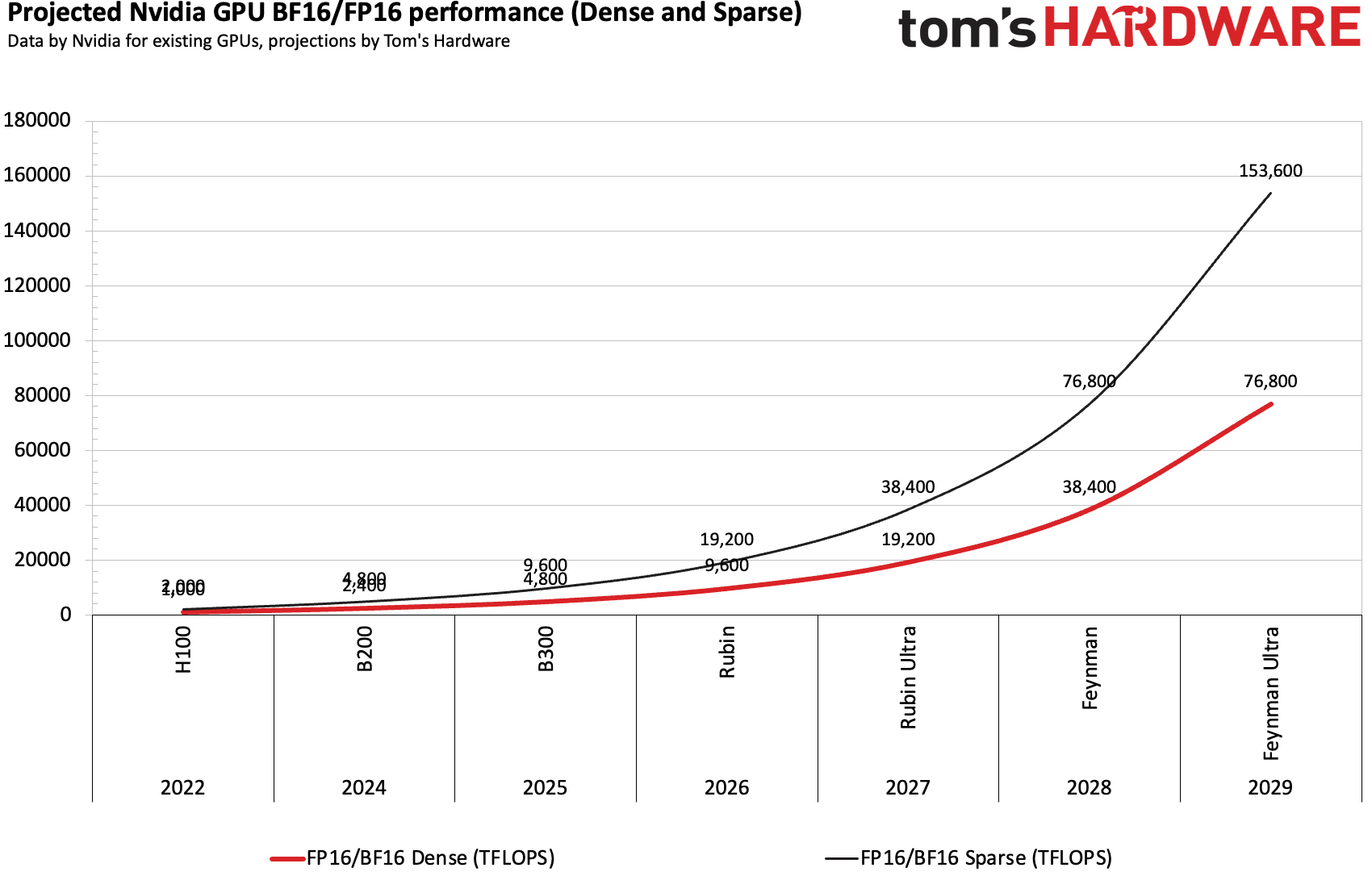
    One Nvidia H100 GPU can deliver around 1,000 FP16/BF16 TFLOPS for AI training (these are currently the most popular formats for AI training), so 50 million of such AI accelerators will have to deliver 50 FP16/BF16 ExaFLOPS for AI training by 2030. Based on the current performance improvement trends, this is more than achievable over the next five years.

    Only 650,000 Feynman Ultra GPUs

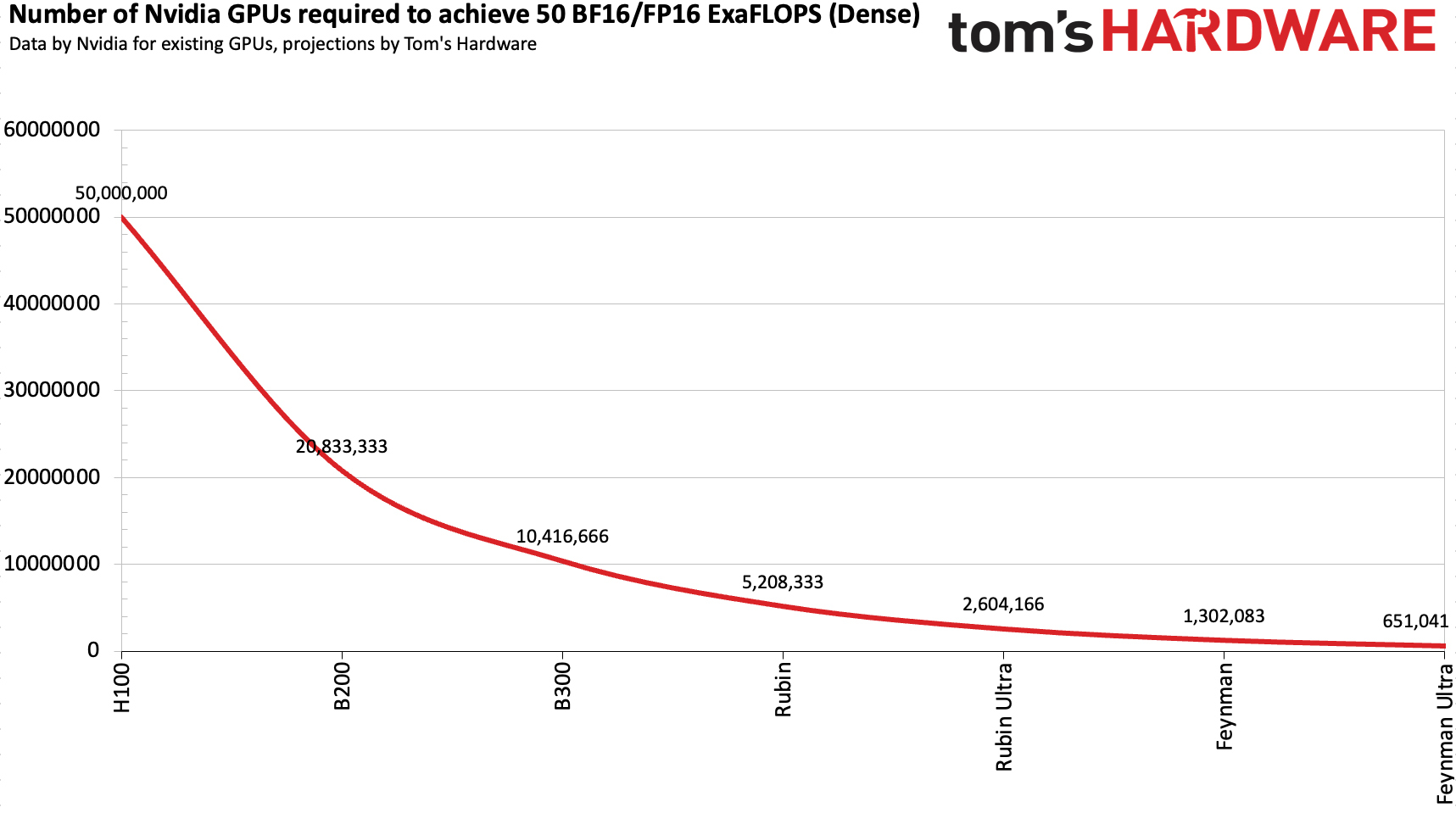
    Assuming that Nvidia (and others) will continue to scale BF16/FP16 training performance of its GPUs at a pace slightly slower than with the Hopper and Blackwell generations, 50 BF16/FP16 ExaFLOPS will be achievable using 1.3 million GPUs in 2028 or 650,000 in 2029, based on our speculative guesses.

    If xAI has enough money to spend on Nvidia hardware, it is even possible that the goal of getting to 50 ExaFLOPS for AI training will be achieved even earlier.

    Graph displaying exponential reduction in GPUs required by the arrival of Feynman Ultra

    (Image credit: Tom’s Hardware)

    Elon Musk’s xAI is already among the fastest companies to deploy the latest AI GPU accelerators to boost its training capability. The company already runs its Colossus 1 supercluster that uses 200,000 H100 and H200 accelerators based on the Hopper architecture, as well as 30,000 GB200 units based on the Blackwell architecture. In addition, the company aims to build its Colossus 2 cluster consisting of 550,000 GB200 and GB300 nodes (each of such nodes has two GPUs, so the cluster will feature over a million GPUs) with the first nodes set to come online in the coming weeks, according to Musk.

    Steady performance increases

    Nvidia (and other companies) recently switched to a yearly cadence of new AI accelerators release and Nvidia’s schedule now resembles Intel’s Tick-Tock model from back in the day though in this case we are talking about an architecture -> optimization approach using a single production node (e.g., Blackwell -> Blackwell Ultra, Rubin -> Rubin Ultra) rather than switching to a new process technology for a known architecture.

    Stay On the Cutting Edge: Get the Tom’s Hardware Newsletter

    Get Tom’s Hardware’s best news and in-depth reviews, straight to your inbox.

    Such an approach ensures significant performance increases every year, which in turn ensures dramatic longer-term performance gains. For example, Nvidia claims its Blackwell B200 delivers 20,000 times higher inference performance than the 2016 Pascal P100, offering around 20,000 FP4 TFLOPS versus the P100’s 19 FP16 TFLOPS. Though not a direct comparison, the metric is relevant for inference tasks. Blackwell is also 42,500 times more energy efficient than Pascal when measured by joules per generated token.

    Swipe to scroll horizontally
    Nvidia enterprise GPU roadmap

    Year

    2022

    2023

    2024

    2025

    2026

    2027

    Architecture

    Hopper

    Hopper

    Blackwell

    Blackwell Ultra

    Rubin

    Rubin

    GPU

    H100

    H200

    B200

    B300 (Ultra)

    VR200

    VR300 (Ultra)

    Process Technology

    4N

    4N

    4NP

    4NP

    N3P (3NP?)

    N3P (3NP?)

    Physical Configuration

    1 x Reticle Sized GPU

    1 x Reticle Sized GPU

    2 x Reticle Sized GPUs

    2 x Reticle Sized GPUs

    2 x Reticle Sized GPUs, 2x I/O chiplets

    4 x Reticle Sized GPUs, 2x I/O chiplets

    FP4 PFLOPs (per Package)

    –

    –

    10

    15

    50

    100

    FP8/INT6 PFLOPs (per Package)

    2

    2

    4.5

    10

    ?

    ?

    INT8 PFLOPS (per Package)

    2

    2

    4.5

    0.319

    ?

    ?

    BF16 PFLOPs (per Package)

    0.99

    0.99

    2.25

    5

    ?

    ?

    TF32 PFLOPs (per Package)

    0.495

    0.495

    1.12

    2.5

    ?

    ?

    FP32 PFLOPs (per Package)

    67

    67

    1.12

    0.083

    ?

    ?

    FP64/FP64 Tensor TFLOPs (per Package)

    34/67

    34/67

    40

    1.39

    ?

    ?

    Memory

    80 GB HBM3

    141 GB HBM3E

    192 GB HBM3E

    288 GB HBM3E

    288 GB HBM4

    1 TB HBM4E

    Memory Bandwidth

    3.35 TB/s

    4.8 TB/s

    8 TB/s

    4 TB/s

    13 TB/s

    32 TB/s

    GPU TDP

    700 W

    700 W

    1200 W

    1400 W

    1800 W

    3600 W

    CPU

    72-core Grace

    72-core Grace

    72-core Grace

    72-core Grace

    88-core Vera

    88-core Vera

    Indeed, Nvidia and others are not slowing down with performance advancements. The Blackwell Ultra architecture (B300-series) offers a 50% higher FP4 performance (15 FPLOPS) compared to the original Blackwell GPUs (10 FPLOPS) for AI inference, as well as two times higher performance for BF16 and TF32 formats for AI training, yet at the cost of lower INT8, FP32, and FP64 performance. For reference, BF16 and FP16 are typical formats used for AI training (though FP8 seems to be evaluated as well), so it is reasonable to expect Nvidia to boost performance in these formats with its next-generation Rubin, Rubin Ultra, Feynman, and Feynman Ultra GPUs.

    Exponential increase in Nvidia GPUs FP16 and BF16 performance on a graph.

    (Image credit: Tom’s Hardware)

    Depending on how we count, Nvidia increased FP16/BF16 performance by 3.2 times with H100 (compared to A100), then by 2.4 times with B200 (compared to H100), and then by 2.2 times with B300 (compared to B200). Actual training performance of course depends not only on pure math performance of new GPUs, but also on memory bandwidth, model size, parallelism (software optimizations and interconnect performance), and usage of FP32 for accumulations. Yet, it is safe to say that Nvidia can double the training performance (with FP16/BF16 formats) of its GPUs with each new generation.

    Assuming that Nvidia can achieve the aforementioned performance increases with its four subsequent generations of AI accelerators based on the Rubin and Feynman architectures, it is easy to count that around 650,000 Feynman Ultra GPUs will be needed to get to around 50 BF16/FP16 ExaFLOPS sometime in 2029.

    Gargantuan power consumption

    But while Elon Musk’s xAI and probably other AI leaders will probably get their 50 BF16/FP16 ExaFLOPS for AI training over the next four or five years, the big question is how much power will such a supercluster consume? And, how many nuclear power plants will be needed to feed one?

    One H100 AI accelerator consumes 700W, so 50 million of these processors will consume 35 gigawatts (GW), which is equal to the typical power generated by 35 nuclear power plants, making it unrealistic to power such a massive data center today. Even a cluster of Rubin Ultra will require around 9.37 GW, which is comparable to the power consumption of French Guiana. Assuming that the Feynman architecture doubles performance per watt for BF16/FP16 compared to the Rubin architecture (keep in mind that we are speculating), a 50 ExaFLOPS cluster will still need 4.685 GW, which is well beyond 1.4 GW – 1.96 GW required for xAI’s Colossus 2 data center with around a million AI accelerators.

    Swipe to scroll horizontally

    GPU Model

    TFLOPS (Dense)

    Power per GPU (W)

    GPUs Needed

    Total Power (GW)

    H100

    1,000

    700

    50,000,000

    35

    B200

    2,400

    1,200

    20,833,333

    25.00

    B300

    4,800

    1,400

    10,416,666

    14.58

    Rubin

    9,600

    1,800

    5,208,333

    9.37

    Rubin Ultra

    19,200

    3,600

    2,604,166

    9.37

    Feynman

    38,400

    ?

    1,302,083

    4.685 (?)

    Can Elon Musk’s xAI get 4.685 GW of power to feed a 50 ExaFLOPS data center in 2028 – 2030? That is something that clearly remains to be seen.

    Follow Tom’s Hardware on Google News to get our up-to-date news, analysis, and reviews in your feeds. Make sure to click the Follow button.


    Source: Latest from Tom’s Hardware.

  • A Pill for Sleep Apnea Could Be on the Horizon

    July 23, 2025
    Health

    Experts say that if the new drug gets approved, it may lead to a big shift in how we treat the condition.


    Source: NYT > Well.

  • HOW to MAKE TECH HOUSE…the RIGHT WAY! ⚡️

    HOW to MAKE TECH HOUSE…the RIGHT WAY! ⚡️

    July 23, 2025
    Music

    Source: YouTube.

  • Solving the inference problem for open source AI projects with GitHub Models

    July 23, 2025
    Software

    AI features can make an open source project shine. At least, until setup asks for a paid inference API key.  Requiring contributors or even casual users to bring their own large language model (LLM) key stops adoption in its tracks:

    $ my-cool-ai-tool Error: OPENAI_API_KEY not found

    Developers may not want to buy a paid plan just to try out your tool, and self hosting a model can be too heavy for laptops or GitHub Actions runners. 

    GitHub Models solves that friction with a free, OpenAI-compatible inference API that every GitHub account can use with no new keys, consoles, or SDKs required. In this article, we’ll show you how to drop it into your project, run it in CI/CD, and scale when your community takes off.

    Let’s jump in.

    AI features feel ubiquitous today, but getting them running locally is still a challenge for a few reasons:

    • Paid APIs: The simplest path is to ask users for an OpenAI or Anthropic key. That’s a non-starter for many hobbyists and students because paid APIs are too expensive.
    • Local models: Running a 2 B-parameter LLM can work for lightweight tasks, but anything that requires more intelligence will quickly blow past typical laptop memory — let alone the 14 GB container that backs a GitHub Actions runner.
    • Docker images and weights: You can bundle a model with your app, but distributing multi-gigabyte weights balloons install size and slows CI.

    Every additional requirement filters out potential users and contributors. What you need is an inference endpoint that’s:

    1. Free for public projects
    2. Compatible with existing OpenAI SDKs
    3. Available wherever your code runs, like your laptop, server, or Actions runner

    That’s what GitHub Models provides.

    GitHub Models in a nutshell

    • What it is: A REST endpoint that speaks the chat/completions spec you already know.
    • What you get: A curated set of models (GPT-4o, DeepSeek-R1, Llama 3, and more) hosted by GitHub.
    • Who can call it: Anyone with a GitHub Personal Access Token (PAT), or a repository’s built-in GITHUB_TOKEN when you opt-in via permissions.
    • How much it costs: Free tier for all personal accounts and OSS orgs; metered paid tier unlocks higher throughput and larger context windows.

    Because the API mirrors OpenAI’s, any client that accepts a baseURL will work without code changes. This includes OpenAI-JS, OpenAI Python, LangChain, llamacpp, or your own curl script.

    How to get started with GitHub Models

    Since GitHub Models is compatible with the OpenAI chat/completions API, almost every inference SDK can use it. To get started, you can use the OpenAI SDK:

    import OpenAI from "openai"; const openai = new OpenAI({ baseURL: "https://models.github.ai/inference/chat/completions", apiKey: process.env.GITHUB_TOKEN // or any PAT with models:read }); const res = await openai.chat.completions.create({ model: "openai/gpt-4o", messages: [{ role: "user", content: "Hi!" }] }); console.log(res.choices[0].message.content);

    If you write your AI open source software with GitHub Models as an inference provider, all GitHub users will be able to get up and running with it just by supplying a GitHub Personal Access Token (PAT).

    And if your software runs in GitHub Actions, your users won’t even need to supply a PAT. By requesting the models: read permission in your workflow file, the built-in GitHub token will have permissions to make inference requests to GitHub Models. This means you can build a whole array of AI-powered Actions that can be shared and installed with a single click. For instance:

    • Code review or PR triage bots
    • Smart issue tagging workflows
    • Weekly repository activity report generators
    • And anything else that a GitHub Action can do

    Plus, using GitHub Models makes it easy for your users to set up AI inference. And that has another positive effect: it’s easier for your contributors to set up AI inference as well. When anyone with a GitHub account can run your code end to end, you’ll be able to get contributions from the whole range of GitHub users, not just the ones with an OpenAI key.

    Zero-configuration CI with GitHub Actions

    Publishing an Action that relies on AI used to require users to add their inference API key as a GitHub Actions secret. Now you can ship a one-click install:

    yaml # .github/workflows/triage.yml permissions: contents: read issues: write models: read # 👈 unlocks GitHub Models for the GITHUB_TOKEN jobs: triage: runs-on: ubuntu-latest steps: - uses: actions/checkout@v4 - name: Smart issue triage run: node scripts/triage.js

    The runner’s GITHUB_TOKEN carries the models:read scope, so your Action can call any model without extra setup. This makes it well suited for:

    • Automated pull request summaries
    • Issue deduplication and tagging
    • Weekly repository digests
    • Anything else you can script in an Action

    Scaling when your project takes off

    The GitHub Models inference API is free for everyone. But if you or your users want to do more inference than the free rate limits allow, you can turn on paid inference in your settings for significantly larger context windows and higher requests-per-minute. 

    When your community grows, so will traffic. So it’s important to consider the following: 

    • Requests per minute (RPM): While the free tier offers default limits, the paid tier offers multiples higher.
    • Context window: Free tier tops out at standard model limits; paid enables 128k tokens on supported models.
    • Latency: The paid tier runs in its own separate deployment, so you’re not in the same queue as free tier users.

    To get started, you can enable paid usage in Settings > Models for your org or enterprise. Your existing clients and tokens will keep working (but they’ll be faster and support bigger contexts).

    Take this with you

    LLMs are transforming how developers build and ship software, but requiring users to supply their own paid API key can be a barrier to entry. The magic only happens when the first npm install, cargo run, or go test just works.

    If you maintain an AI-powered open source codebase, you should consider adding GitHub Models as a default inference provider. Your users already have free AI inference via GitHub, so there’s little downside to letting them use it with your code. That’s doubly true if your project is able to run in GitHub Actions. The best API key is no API key!

    By making high-quality inference a free default for every developer on GitHub, GitHub Models gets rid of the biggest blocker to OSS AI adoption. And that opens the door to more contributions, faster onboarding, and happier users.

    Want to give it a try? Check out the GitHub Models documentation or jump straight into the API reference and start shipping AI features that just work today.

    Want to give it a try? Check out the GitHub Models documentation or jump straight into the API reference and start shipping AI features that just work today.

    The post Solving the inference problem for open source AI projects with GitHub Models appeared first on The GitHub Blog.


    Source: The GitHub Blog.

Previous Page
1 … 870 871 872 873 874 … 911
Next Page
MONIMEGA
  • Instagram
  • Facebook
  • Twitter
Gestisci Consenso
Per fornire le migliori esperienze, utilizziamo tecnologie come i cookie per memorizzare e/o accedere alle informazioni del dispositivo. Il consenso a queste tecnologie ci permetterà di elaborare dati come il comportamento di navigazione o ID unici su questo sito. Non acconsentire o ritirare il consenso può influire negativamente su alcune caratteristiche e funzioni.
Funzionale Always active
L'archiviazione tecnica o l'accesso sono strettamente necessari al fine legittimo di consentire l'uso di un servizio specifico esplicitamente richiesto dall'abbonato o dall'utente, o al solo scopo di effettuare la trasmissione di una comunicazione su una rete di comunicazione elettronica.
Preferenze
L'archiviazione tecnica o l'accesso sono necessari per lo scopo legittimo di memorizzare le preferenze che non sono richieste dall'abbonato o dall'utente.
Statistiche
L'archiviazione tecnica o l'accesso che viene utilizzato esclusivamente per scopi statistici. L'archiviazione tecnica o l'accesso che viene utilizzato esclusivamente per scopi statistici anonimi. Senza un mandato di comparizione, una conformità volontaria da parte del vostro Fornitore di Servizi Internet, o ulteriori registrazioni da parte di terzi, le informazioni memorizzate o recuperate per questo scopo da sole non possono di solito essere utilizzate per l'identificazione.
Marketing
L'archiviazione tecnica o l'accesso sono necessari per creare profili di utenti per inviare pubblicità, o per tracciare l'utente su un sito web o su diversi siti web per scopi di marketing simili.
  • Manage options
  • Manage services
  • Manage {vendor_count} vendors
  • Read more about these purposes
Visualizza le preferenze
  • {title}
  • {title}
  • {title}